


HumanValue Career Intelligence | Tanzania | Prepared 8 November 2026
A useful supplier-comparison sheet makes the differences between quotations visible before anyone recommends a purchase. Check that the suppliers are quoting for the same specification and quantity, separate the stated costs from unanswered questions, and show who must approve the decision. For a purchasing assistant applicant in Tanzania, a fictional comparison is a practical way to demonstrate careful judgement.
The exercise below uses invented suppliers and prices for office stationery. The amounts are arithmetic examples, not market rates, tax advice or a purchasing recommendation. Follow the actual employer’s procurement process and approval rules in a real role.
1. Establish a common requirement
Start with the requirement, not the quotations. Define the item, unit of measure, quantity, necessary quality features, delivery location and required date. If the request says twenty packs of folders, confirm how many folders are in a pack. Otherwise one supplier’s lower pack price may refer to fewer items.
For the practice case, assume twenty identical packs of A4 document folders delivered to one Dar es Salaam office. Write that requirement at the top of the workbook. Keep any requested brand, sample or performance condition explicit. A substitute product should be identified as a variation that needs a decision, not silently treated as equivalent.
2. Record the quotation as it was received
Create a source register with quotation reference, supplier label, issue date, validity period, currency, product description, quantity basis and evidence location. Use invented names such as Supplier A, B and C for a portfolio. Keep the original fictional quotation and your interpretation separate so a reviewer can trace the figures.
When an actual quotation is unclear, ask a specific question. “Does your quoted pack contain ten folders?” is more useful than “Please confirm everything”. Record the reply and date. An assumption should remain labelled until evidence resolves it.
3. Compare the costs that are actually stated
| Supplier | Unit price, TZS | Goods subtotal | Delivery | Stated-cost subtotal |
|---|---|---|---|---|
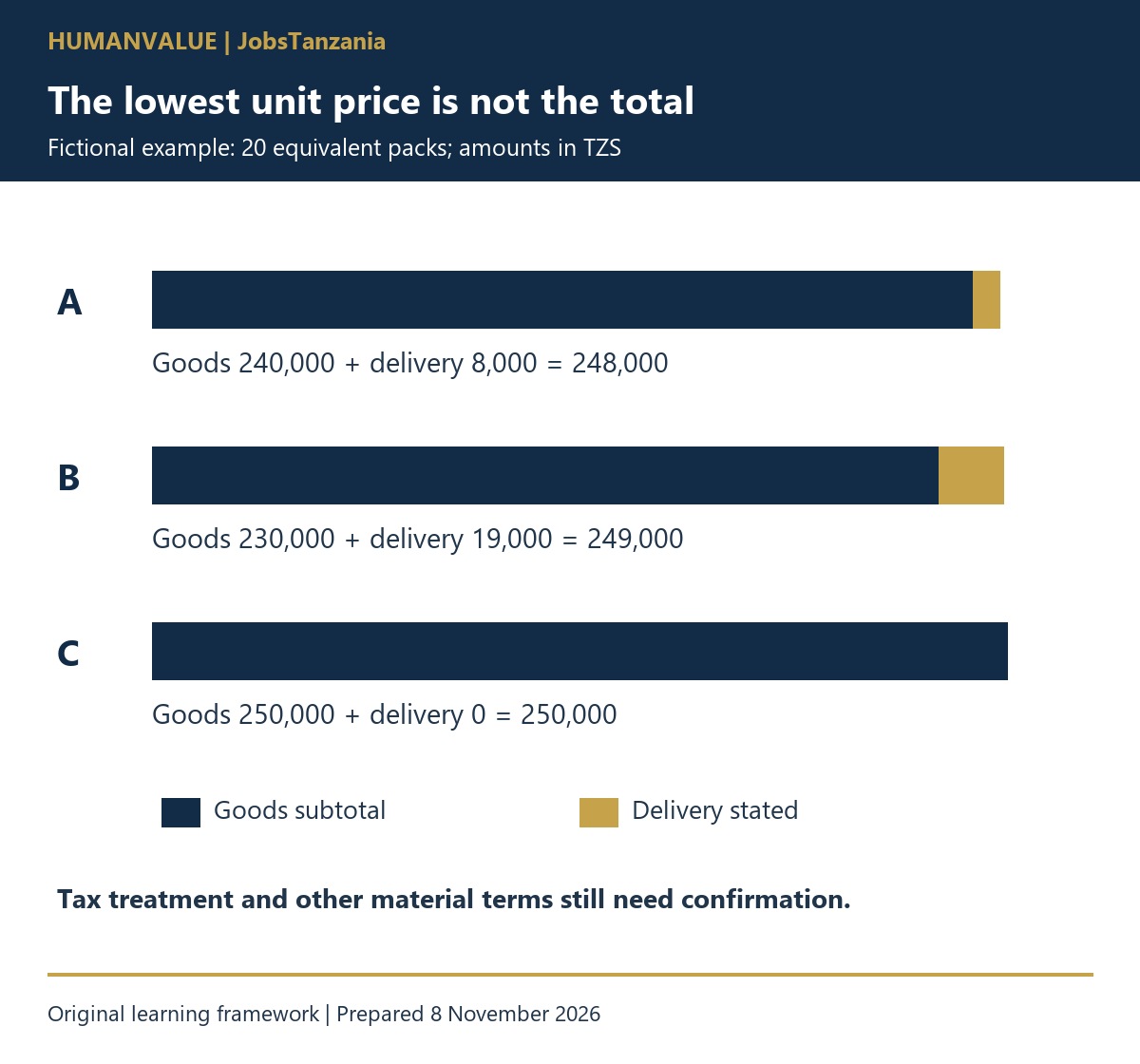
| A | 12,000 | 240,000 | 8,000 | 248,000 |
| B | 11,500 | 230,000 | 19,000 | 249,000 |
| C | 12,500 | 250,000 | Included | 250,000 |
The goods subtotal is quantity multiplied by unit price. The stated-cost subtotal adds the delivery amount given in the fictional quotation. Supplier B has the lowest unit price, while A has the lowest subtotal among these stated costs. That does not establish the final payable amount or the best supplier: tax treatment and other material terms are still unresolved.
Do not enter zero for a cost simply because the quotation is silent. Use “not stated” and a clarification action. If currencies differ, keep the original figures and identify the authorised conversion basis separately. A portfolio does not need live exchange rates to demonstrate that you recognise this issue.
For the spreadsheet skills behind this comparison, HumanValue Workplace Excel Essentials includes formulas, data organisation, sorting, filtering and reporting practice. Build the calculation transparently and keep the procurement decision with the authorised role.
4. Put non-price differences beside the figures
A comparison should show delivery commitment, quotation validity, payment terms, warranty or support where relevant, and any specification variation. Record what is evidenced and what needs confirmation. A verbal suggestion that stock is available should not become a guaranteed delivery date in your recommendation.
The CIPS glossary distinguishes purchase price from wider total-cost concepts. It is a useful terminology reference. In this exercise, your task is narrower: expose material differences and missing information so the authorised buyer can make an informed decision.
5. Write a recommendation that includes its conditions
Fictional comparison note: “Supplier A has the lowest subtotal of the costs currently stated for twenty equivalent packs. Before a purchase decision, confirm consistent tax treatment, delivery commitment and quotation validity for all three offers. The comparison does not yet establish a final payable total.”
This wording explains what the calculation proves and what it does not. It is original teaching material. Avoid writing “best supplier” when you have only compared one cost column. If a supervisor chooses a different offer for a documented operational reason, preserve that reason and the approver in the decision record.
6. Make the workbook easy to review
Use one sheet for the common requirement, one for the quotations, one for the comparison and one for open questions. Put units in column headings and store numbers as numbers. Keep formulas visible to a reviewer and avoid typing an unexplained total over a calculated result. Check that all three offers use the same quantity basis.
Ask a peer to trace Supplier B’s subtotal back to the fictional quotation. Then ask what must be clarified before approval. If they cannot find the source or mistake an assumption for a fact, revise the workbook. A neat dashboard is less useful than a traceable calculation.
7. Explain the work honestly in an application
Label the portfolio as a fictional procurement exercise. Describe the requirement you defined, the cost difference you found and the clarification you raised. Do not claim savings for a real business or professional registration from this project. Read the actual vacancy for required qualifications, sector knowledge and systems experience.
Your next step: Build three short fictional quotations and compare them against one common requirement. Explore the HumanValue Learning Center for relevant spreadsheet and workplace learning, then use the free ATS CV scanner to review how clearly your genuine experience is presented.
For a connected inventory workflow, see how a returns register separates reports from authorised decisions.