


A remote employer cannot see your working habits. Your application needs to make some of them visible.
Choose a sample that resembles the work
A portfolio does not need to be a large website. Choose one task relevant to the roles you want: a customer-support response, an operations handover, a simple data explanation or a project update. The sample should demonstrate a skill the vacancy asks for.
The Open University describes professional portfolios as collections of evidence that show experience and capability. The examples below are original practice exercises; they are not assignments from an employer and should not be presented as client work.
Build a realistic but fictional brief
For an operations role, imagine a small supplier has three delayed deliveries. Create a one-page update with the issue, affected deadlines, assumptions, questions and next actions. For a support role, write a response that acknowledges a customer’s problem, requests only necessary information and explains the next step.
For an analyst role, use a small synthetic dataset and show the question, method, result and limitations. A readable explanation matters as much as a colourful chart. Label all invented data clearly.
Show how you work across distance
- State what is complete and what still needs a decision.
- Use explicit dates and time zones in your fictional handover.
- Separate facts, assumptions and questions.
- Make the next action and responsible person easy to find.
- Remove personal details, client information and confidential employer material.
Do not imply that working remotely removes work-permission, tax or contractual requirements. Those depend on where the work is performed, who employs you and the applicable rules. Confirm them through the relevant official channels before accepting an arrangement.
Use the sample selectively
Give the file a descriptive name, check that it opens on a phone and explain in two sentences what it demonstrates. Submit it only where the application permits supporting material. If an employer requests substantial unpaid production work, clarify the purpose, scope and ownership before proceeding.
One relevant, honest sample is more useful than a folder of impressive-looking files you cannot explain.
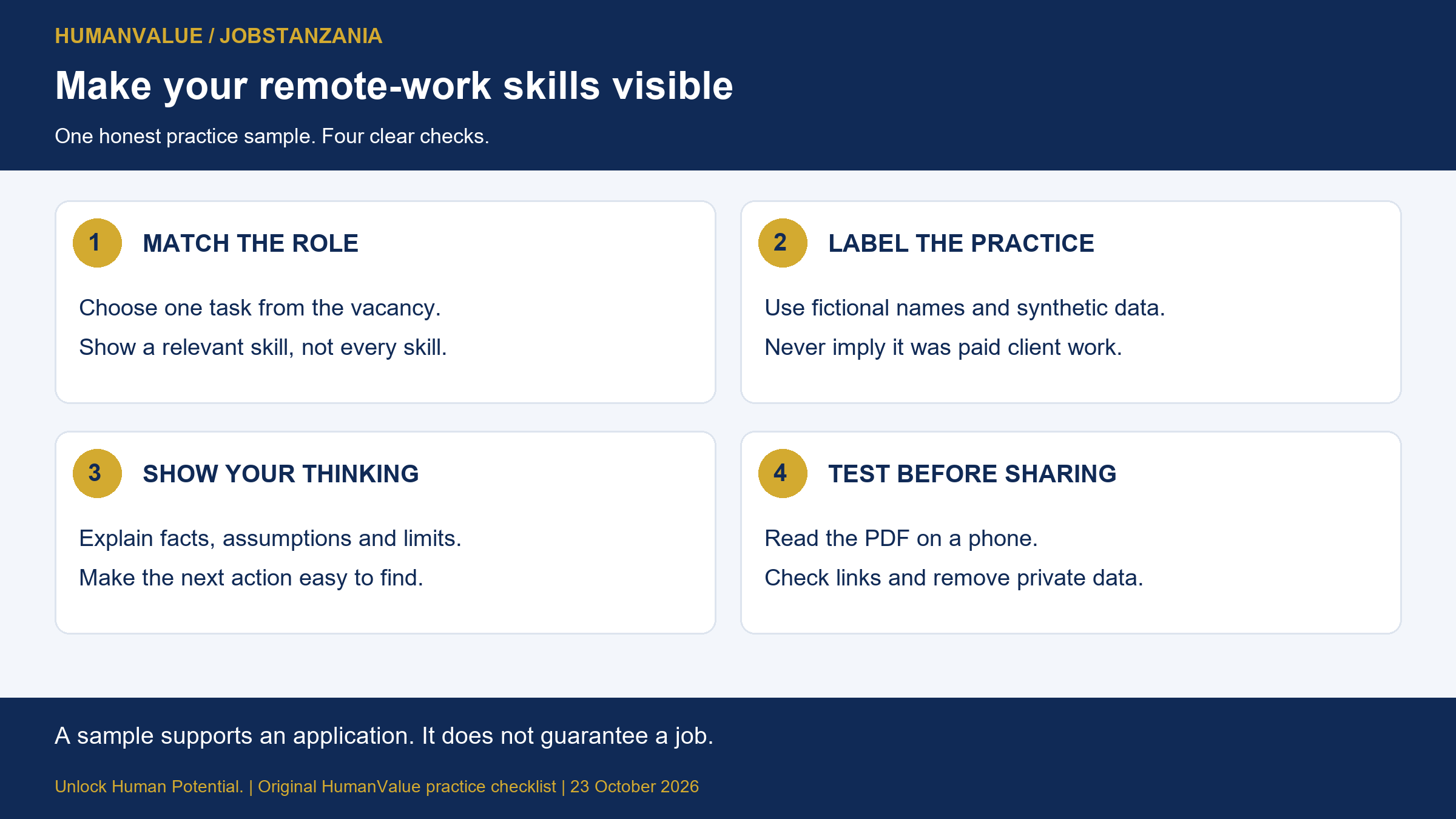
Worked example: an operations handover you can explain
Fictional practice brief: You support a small online retailer from Dar es Salaam. Three orders are delayed. The team lead needs a short update before a colleague starts the next shift. No customer records, actual company data or real delivery promises are involved.
Start with a heading such as “Practice handover: three delayed orders, 23 October 2026, 10:00 EAT”. Then use five short entries. Status: two fictional parcels await dispatch and one awaits address clarification. Evidence: cite your invented order table and label it synthetic. Unknown: the carrier has not confirmed collection. Next action: ask the fictional dispatch lead to confirm readiness by 12:00 EAT. Escalation: if collection is unconfirmed, ask the supervisor to approve a revised customer update.
The useful part is the decision trail. Do not promise delivery on a date your invented evidence cannot support. Explain why you chose an update rather than a refund or replacement, and what additional information would change your recommendation. A reviewer should be able to identify your reasoning without asking you to narrate every line.
A focused practice session
- First 10 minutes: select one requirement in a real vacancy and write a fictional brief that tests it. Keep the employer’s name out of the invented scenario.
- Next 25 minutes: build the sample in a familiar tool. A document, spreadsheet or small code repository is enough when it suits the task.
- Next 15 minutes: write a short note covering the objective, your contribution, assumptions and limitations. If you used AI, describe its role honestly and check every result yourself.
- Final 10 minutes: export a readable version, open it on a phone and check that supporting links work without granting editing access.
This is an optional practice plan, not an employer’s assessment standard. Take more time where accuracy or accessibility requires it. A developer might include a README and sample inputs; a support applicant might include a response and escalation note. Match the format to the role rather than forcing every sample into a presentation.
How to introduce it in an application
A short description can say: “I created a fictional operations handover to demonstrate concise updates, explicit time zones and escalation decisions. It uses synthetic data and includes a note explaining my assumptions.” Adjust that description to what you actually made. Avoid claims about revenue saved, customers served or service levels achieved unless you have real, permitted evidence.
Before submitting, check the vacancy’s attachment and link instructions. Do not use a portfolio to bypass required application questions. Keep a private master copy, share only the relevant version and remove personal details from document properties, screenshots and comments. If a sample contains another person’s work, obtain permission and state your own contribution clearly.
For broader preparation, read our remote-readiness guide for African professionals. A sample can strengthen your evidence, but it cannot confirm that a vacancy is legitimate or that you are eligible to work under its terms.
Your next step
Need help connecting your evidence to an international-facing CV or LinkedIn profile? Explore HumanValue profile support.
Join the conversation: Which work sample would make your ability easier to assess remotely?
Further reading: The Open University: professional profiles and portfolios.