

The US EB-2 National Interest Waiver (NIW) is not a paid job-placement programme or an automatic green card for anyone with a master's degree. It is a discretionary employment-based immigration petition for someone who first qualifies for EB-2 and then demonstrates why the United States should waive the normal job-offer and labour-certification requirements in the national interest. Eligible people may self-petition, but they still need substantial evidence and must navigate immigrant-visa availability and later immigration steps.
For qualified African researchers, engineers, health innovators, founders and other professionals, the useful first question is not 'Can I buy an NIW package?' It is 'What specific work do I propose to advance in the United States, and what independent evidence supports both my qualifications and the importance and feasibility of that work?' This guide explains the separate tests and a practical evidence inventory without predicting approval.
The two gates applicants often confuse
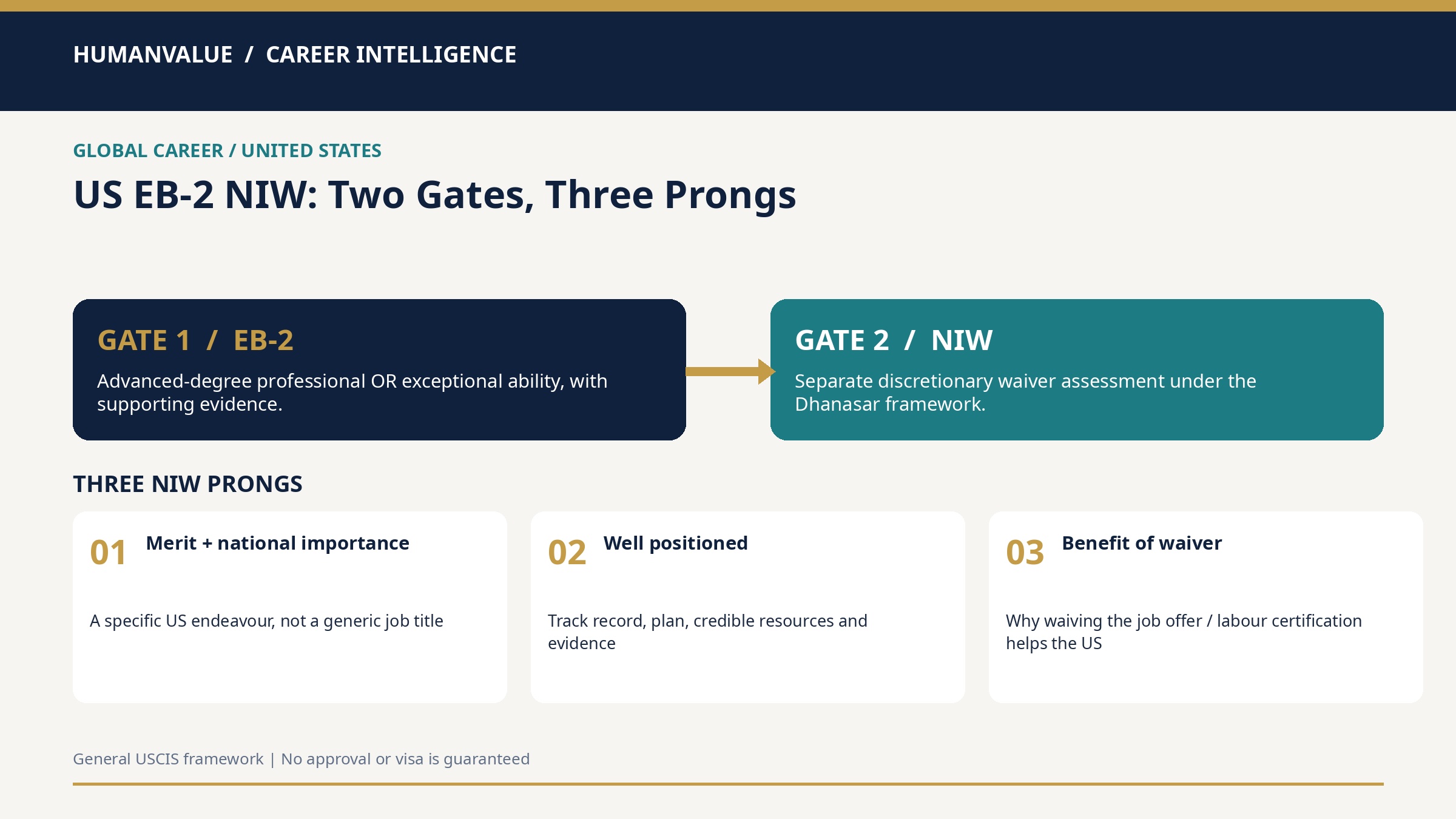
Gate one: EB-2 classification. USCIS evaluates whether the person qualifies as an advanced-degree professional or an individual of exceptional ability under the applicable rules. An advanced degree can be a qualifying US degree or foreign equivalent, and certain combinations of bachelor's education and progressive experience may be relevant under the detailed rules. Exceptional ability has its own evidentiary criteria. An attractive CV alone is not the test.
Gate two: national interest waiver. Even if EB-2 eligibility is established, USCIS separately assesses whether waiving the job offer and labour certification is justified. The official USCIS Policy Manual update of 15 January 2025 emphasises that the underlying classification and waiver are distinct decisions. Do not assume that a master's degree, a publication count or a senior title automatically satisfies both.
The waiver can allow a self-petition without a sponsoring US employer. It does not waive the requirement to meet immigration admissibility rules, obtain an immigrant visa when one is available, or comply with any applicable legal restrictions. Nor does a filed or approved petition itself authorise someone abroad to work in the United States.
Understand the three-part Dhanasar framework
USCIS applies the framework from Matter of Dhanasar. First, the proposed endeavour must have substantial merit and national importance. Second, the applicant must be well positioned to advance it. Third, on balance, it must benefit the United States to waive the job-offer and labour-certification requirements. The official USCIS policy guidance explains how evidence is considered across these prongs.
The first prong is not satisfied merely because an occupation is socially useful. 'I am a software engineer and technology matters' is too broad to describe a specific endeavour. A stronger, still hypothetical proposition is: 'I intend to develop and implement a reproducible cybersecurity method for a defined class of critical infrastructure operators, supported by pilot results and identifiable US stakeholders.' That statement would still require evidence of national importance, not just a polished narrative.
The second prong asks whether the individual is well positioned, not whether success is guaranteed. Relevant evidence may include education, prior results, publications, technical work, business plans, funding, collaborators, letters and documented progress. Quality, relevance and independent verification matter more than the number of pages.
The third prong weighs why dispensing with the normal job-offer and labour-certification process is beneficial in the particular case. A generic claim that the US needs skilled workers is not enough. The petition must connect the applicant's specific circumstances and endeavour to the requested waiver.
Turn an impressive career into a verifiable endeavour
A candidate may have built a payment platform in Tanzania, managed an electricity project, researched infectious diseases or improved agricultural supply chains. These achievements can be meaningful, but the NIW case must explain the future US endeavour rather than simply list past success. What problem will be addressed? For whom? By what method? Why is the expected effect broader than one ordinary employer's commercial benefit? What evidence supports the plan?
Start with a one-page endeavour brief. Include the intended work, target beneficiaries, geographic or sector relevance, method, milestones, required partners and the evidence already available. Then write a separate page about the applicant's own track record. This prevents a common error: describing a nationally important topic without showing why this particular person is positioned to advance it.
An applicant who has never worked in the United States can still explore the route, but must be realistic about access to partners, market conditions, resources and lawful implementation. Inventing US contracts, letters or customer interest is both unethical and damaging. A preliminary conversation is not a signed agreement; a business idea is not demonstrated market adoption.
The evidence matrix: six useful columns
Create a table with claim, relevant prong, supporting document, independent verifier, permission to disclose, and gap or next action. Example: 'Designed a predictive-maintenance method' should link to an authorised technical report or verifiable project record, identify the applicant's personal contribution, and explain why it is relevant to the proposed US work. A certificate of attendance may show learning but cannot prove a national-level outcome by itself.
Separate four kinds of evidence. Identity and qualification evidence establishes the person's education and experience. Contribution evidence shows what they personally built, led or discovered. Impact evidence shows credible outcomes and reach, with context. Future-endeavour evidence shows a plausible plan and supporting relationships or resources. Avoid submitting confidential patient data, proprietary code or personal information without lawful permission.
Recommendation letters are most useful when the writer can explain direct knowledge, specific achievements and their significance. Generic praise from a famous person may be less persuasive than a detailed letter from a knowledgeable independent expert. Letters must be genuine; paying for fabricated endorsements or misleading documents creates serious risk.
A fictional Tanzanian engineering example
Consider Neema, a fictional Tanzanian engineer who has spent seven years developing methods to reduce unplanned downtime in water-pumping infrastructure. Her employer permits disclosure of anonymised results, and independent technical partners can verify the work. She proposes a US-focused project to adapt the method to a documented infrastructure need.
Her first task is to establish EB-2 eligibility from qualifications and experience. Her second is to demonstrate substantial merit and national importance of the proposed US endeavour, not simply that water infrastructure is important. Her third is to show why her track record, method, resources and relationships make her well positioned. Finally, she must explain why a waiver would benefit the US under the third prong. A credible evidence file makes the case assessable; it does not establish that USCIS will approve it.
Compare a second fictional candidate who has a degree and a generic proposal saying 'I will create jobs in America'. Without a concrete plan, relevant evidence or a defensible explanation of national importance, the narrative is weak. This contrast is a planning example, not a prediction of any person's eligibility.
NIW approval, immigrant visa and work authorisation are different steps
The petition is commonly filed using Form I-140, subject to the correct edition, fee, instructions and filing address. USCIS reviews the petition, but a favourable decision is not itself a visa or entry document. Applicants outside the United States may subsequently need consular processing; applicants already in the US have different adjustment-of-status questions. Both routes depend on individual circumstances and visa-number availability.
The US Department of State October 2026 Visa Bulletin lists EB-2 Final Action Dates and Dates for Filing by chargeability. For most countries in the 'all chargeability areas except those listed' group, the October 2026 EB-2 Final Action Date is 1 January 2025 and the Dates for Filing date is 15 March 2026. These are dated cutoffs, not estimated processing times. Chargeability may not be identical to citizenship, and the applicable filing chart can differ by procedure. Always check the current bulletin and USCIS filing-chart announcement before taking action.
Government filing fees, premium-processing availability, document requirements and appointment timelines can change. Do not budget from a social-media screenshot. Confirm the latest official USCIS Form I-140 page, relevant instructions and Department of State guidance, and obtain qualified US immigration advice where appropriate.
A 30-day evidence audit before committing money
Week one: test the threshold. Read the official EB-2 and NIW rules. Map your degrees, experience and other credentials to the underlying classification. Write the proposed US endeavour in 150 plain-language words and list what would need to be true for it to matter nationally.
Week two: inventory proof. Gather authorised employment letters, academic records, public research, product evidence, independent recognition and relevant outcomes. Create a gap list. Do not spend the week writing a glossy narrative that lacks source documents.
Week three: assess future feasibility. Identify genuine potential collaborators, stakeholders, business or research resources and realistic milestones. Distinguish established relationships from prospective contacts. Confirm that confidential material can be lawfully used or redacted.
Week four: professional review. Compare the matrix against the current USCIS guidance. Where material gaps or complex immigration history exist, consult a qualified US immigration lawyer or authorised provider. Only then decide whether petition preparation is proportionate to the cost and uncertainty.
What JobsTanzania and HumanValue can, and cannot, do
The JobsTanzania Global Career Intelligence archive offers international-career research. The HumanValue Learning Center can support career skills and evidence-building, while the free ATS CV scanner may help improve readability of a professional CV. These are career-preparation resources, not US immigration legal services or USCIS endorsement.
The public International Opportunities catalogue primarily describes Europe and UAE programmes and an optional TZS 50,000 career/document-readiness assessment. That assessment may help organise a CV and general career-readiness questions within its published scope. It is not an EB-2 NIW eligibility opinion, an immigration petition service, an American employer referral or a visa guarantee. Do not buy it on the assumption that it includes any of those things.
FAQs
Do I need a US employer to file an NIW petition?
A national interest waiver can allow a qualifying applicant to self-petition without a job offer. That does not remove the EB-2 and NIW evidentiary requirements or later immigration steps.
Does a master's degree guarantee NIW approval?
No. The degree may be relevant to underlying EB-2 classification; the national interest waiver is separately assessed.
Can African work experience and research count?
Potentially, if relevant and credibly documented. The central question is how the evidence supports the proposed endeavour and applicable criteria, not the continent where the work occurred.
Does an approved I-140 mean I can immediately move to the US?
No. Visa availability, consular or adjustment processing and admissibility requirements are separate.
Does HumanValue assess my legal NIW eligibility?
The listed international career-readiness assessment is not a US immigration legal determination. Seek appropriately qualified legal advice for an individual NIW case.
The right next step
Before paying anyone for an 'EB-2 package', build a one-page endeavour brief and an evidence matrix. Compare both against the USCIS NIW policy update and the current Visa Bulletin. If your immediate gap is career documentation, use appropriate JobsTanzania learning and CV tools. If the gap is legal eligibility, obtain qualified US immigration advice. A serious international career plan begins by separating professional readiness from legal permission.
Editorial note: general information as at 25 October 2026, not legal advice, an offer of US employment, or a prediction of immigration approval. Verify official rules on the day of filing.