


Quick answer
The U.S. Bureau of Labor Statistics reports a median annual wage of US$105,850 for computer systems analysts in May 2025, the latest published benchmark for this 2026 career guide. Employment is projected to grow 8% from 2025 to 2035, with about 32,900 openings per year on average. These are US occupational statistics, not a promise of a particular salary, remote contract or visa sponsorship.
Review the underlying BLS Occupational Outlook Handbook to compare the median with your industry, experience and location.
What a computer systems analyst actually does
Systems analysts examine how an organisation works, identify system weaknesses and design improvements that balance technical feasibility with business needs. They interview stakeholders, model processes, analyse costs, define requirements, work with developers and security teams, test changes and measure outcomes.
The job is not simply writing code. A strong analyst can explain why a system change matters, what it costs, how risk is controlled and how success will be measured.
Salary benchmark and industry differences
The BLS May 2025 median was US$105,850 annually. The lowest-paid 10% earned less than US$67,340 and the highest-paid 10% more than US$167,710. This is a distribution of workers, not a starting-salary forecast.
Selected May 2025 industry medians reported by BLS include computer systems design and related services at US$108,270, management of companies at US$107,980, information at US$107,240, finance and insurance at US$106,000, and federal/state/local government excluding education and hospitals at US$100,190. Salary comparisons should also account for location, seniority, benefits and taxation.
Why employers continue to need analysts
BLS projects employment rising from about 544,400 positions in 2025 to 587,200 in 2035. The projected 8% increase reflects organisations modernising systems, integrating technology and managing complex workflows. AI investment can create analysis work, but it also changes the tools analysts use.
A good candidate should demonstrate practical requirements analysis, process mapping, stakeholder communication, data literacy, cybersecurity awareness, testing and change management rather than relying on a generic software list.
The five-stage career portfolio
Build one case study around a real business problem. Start with a baseline, such as slow invoice approval or frequent stock mismatches. Document stakeholders, map the existing process, evaluate solution options, build a controlled pilot and report measurable outcomes.
An example portfolio could contain a current-state process map, a requirements matrix, risk register, prototype, test plan and a one-page results brief. Do not disclose employer confidential information.
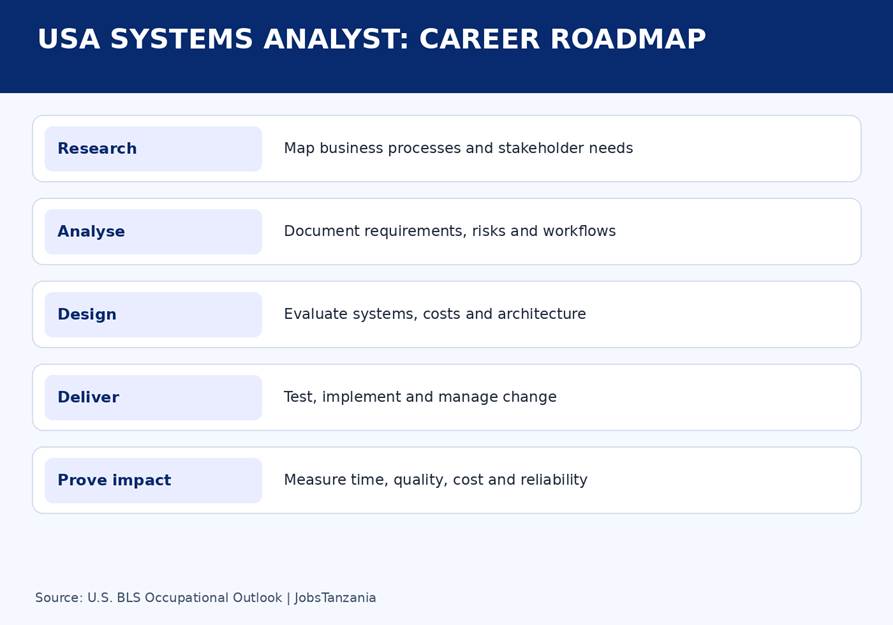
USA Systems Analyst 2026 Career Roadmap
A sample measurable case study
Problem: service tickets take too long to resolve. Method: interview service staff, classify ticket causes, map workflow, define service levels, configure a pilot dashboard and measure performance. Evidence: anonymised workflow, requirement list, before/after dashboard and stakeholder sign-off.
Use verified numbers only. For instance, “reduced median response time from 14 to 9 hours” is useful only if the underlying records support the claim. A hypothetical example should be clearly labelled as hypothetical.
International applicants: employment is not immigration eligibility
The BLS statistics describe US jobs, not the availability of employer sponsorship. For lawful work routes, start with the international visa sponsorship roadmap and verify each employer’s actual work-authorisation requirements.
For applicants based in Tanzania or elsewhere in Africa, also consider legitimate remote consultancy or local multinational roles where systems-analysis capability can be demonstrated without assuming a US employment relationship.
Career progression and learning
Entry pathways include business analysis, application support, systems administration, data analysis and junior requirements roles. Mid-career progression may lead to enterprise systems analysis, product ownership, architecture, transformation management or technology leadership.
Use the HumanValue Learning Center for relevant workplace digital skills and IT leadership development. A training course can strengthen capability, but it does not certify US eligibility or guarantee a job.
Frequently asked questions
Is US$105,850 the average starting salary? No. It is the median for employed computer systems analysts in May 2025.
Does BLS forecast 8% growth? Yes, for 2025–2035, not necessarily for each individual year.
Do all systems analysts need a computer science degree? No. BLS says a bachelor’s degree is typical, and some employers consider other academic backgrounds combined with relevant skills.
Can I work from Africa for a US employer? That depends on the specific employer, employment arrangement, tax, data and legal requirements.
Conclusion: translate technology experience into business value
A strong systems analyst career is built on the ability to improve how an organisation operates, not merely on familiarity with technology. Use the BLS benchmarks to set realistic expectations, then produce a portfolio that proves measurable results, sound controls and stakeholder communication.