


HumanValue Global Career Intelligence | Researched 9 November 2026
Open-source work can provide public evidence of how you identify a problem, make a useful change and respond to review. Describe the contribution precisely: what you proposed, what you personally changed, what was tested and whether the work was accepted. A submitted pull request is not the same as a merged contribution, employment experience or a maintainer’s endorsement.
This guide is for African developers, technical writers, testers and other professionals preparing for international applications. It explains how to build an honest contribution account while respecting the project’s needs. It does not promise a job, payment, immigration eligibility or acceptance of your work.
Choose a project you can understand and genuinely help
Start with a tool or documentation set you use or can learn well enough to evaluate. A meaningful small improvement is preferable to a large change made mainly to decorate a profile. Before investing time, check whether the project is active and whether the proposed work fits its current priorities.
GitHub’s contribution guide recommends reading the project’s requirements, including contribution instructions, testing expectations, licence and security policy. Those project-specific rules should shape your work. Follow the repository’s actual process rather than assuming every project wants the same type of submission.
The Open Source Guides contribution resource also highlights contributions beyond code, including documentation and community work. For a career sample, choose an activity you can explain and support with evidence, rather than claiming a technical role merely because the project contains software.
Define a contribution small enough to review
A useful contribution has a clear problem and a bounded proposed change. “Improve the documentation” is broad. “Clarify the prerequisite for the quickstart’s first command” gives a reviewer something specific to evaluate.
Check existing issues and changes before starting. Someone may already be working on the same problem, or the apparent gap may be intentional. If the project asks for prior discussion or assignment, follow that process. Do not pressure maintainers to accept work because you need a portfolio example.
| Type | Useful bounded contribution | Evidence to retain |
|---|---|---|
| Documentation | Clarify a reproducible setup ambiguity | Original issue, proposed wording and verification |
| Testing | Report a reproducible defect within the project’s rules | Environment, steps, expected and observed behaviour |
| Code | Implement an agreed small fix | Relevant change, tests and review discussion |
| Translation | Improve an accepted localisation contribution | Project terminology, review and actual publication status |
These are examples, not open invitations from any named project. Confirm what the repository currently welcomes. Do not submit a fictional bug report to a real project merely to practise the workflow.
A fictional example: clarify one prerequisite
Imagine an invented documentation project whose quickstart assumes a configuration file already exists. A new reader following the documented steps cannot find that prerequisite. In a fictional demonstration, the contributor reproduces the confusion, proposes a short clarification and tests the revised instructions.
The career account should explain the actual contribution, not claim responsibility for the whole documentation system. If this remains a private fictional exercise, label it as such. If you later make a genuine public contribution, cite the real issue and change while preserving the difference between your work and the maintainers’ decisions.
Fictional portfolio wording: “I tested an invented quickstart from a fresh setup, identified a missing prerequisite and revised the relevant paragraph. I recorded the steps used to check the change. This is a self-directed fictional exercise, not a contribution accepted by an external project.”
For genuine work, replace that statement only with verified facts. A reviewer’s requested changes, an open submission or a declined proposal can still be described honestly. Do not invent a merged status to make the story more attractive.
Keep a record of your reasoning and verification
Retain the problem statement, relevant links, your change and the checks you performed. Explain the environment if it affects reproduction. If you did not run a test because a required service was unavailable, say so rather than implying that every check passed.
Separate automated results from your own observations. A successful spelling check does not prove that a command works. A passing unit test may not cover the user scenario you changed. Describe the practical limit of the evidence without burying the reader in irrelevant logs.
Never include credentials, private employer code or confidential customer data in a public contribution. If you discover a suspected security issue, follow the project’s reporting instructions rather than publishing sensitive details in a general issue thread.
Respond to review as part of the work
A maintainer may ask for a smaller scope, different wording or additional evidence. Read the request carefully and explain what you changed. If you disagree, state the technical or user reason respectfully. The project’s decision about acceptance is separate from your ability to learn from the discussion.
Do not create repeated submissions or unrelated changes to seek attention. Maintain a clear thread of reasoning. If you cannot continue, communicate according to the project’s conventions so that the work is not left in an ambiguous state.
International collaboration can be asynchronous. Write an update that a reviewer in another time zone can understand without arranging a call. Explain the issue, the proposed decision and the evidence needed; avoid demanding an immediate response from volunteers.
Use precise status language in applications
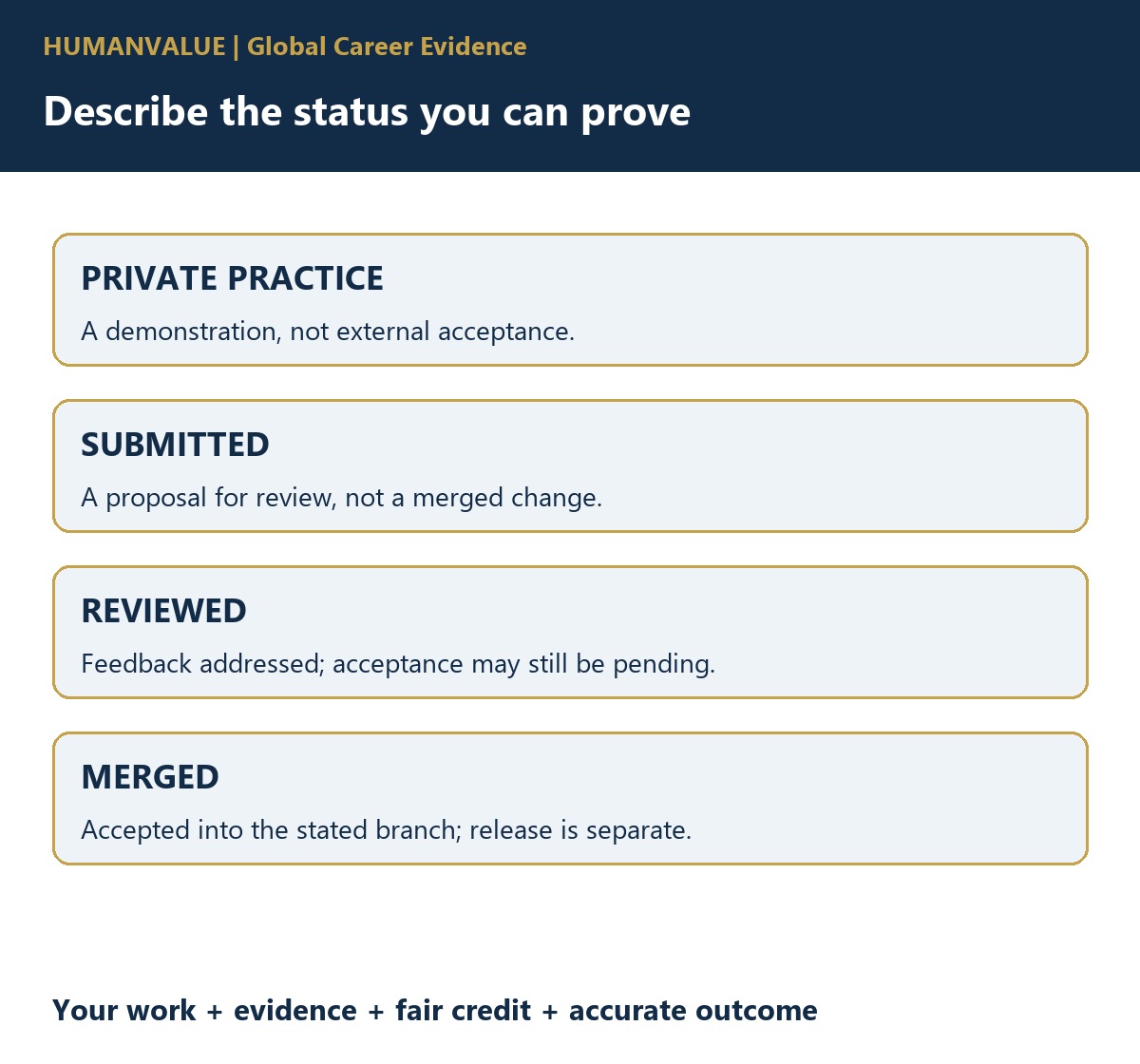
| Actual status | Accurate description | Do not imply |
|---|---|---|
| Private practice | Created and tested a self-directed demonstration | An external project accepted it |
| Submitted | Proposed a change for review | The change is merged or released |
| Reviewed | Responded to specific review feedback | The reviewer endorsed your whole skill set |
| Merged | The linked change was accepted into the stated branch | It has necessarily shipped to every user |
A contribution is not automatically employment. State whether it was voluntary, part of paid work or a learning exercise, as appropriate and permitted. Do not claim the project as a client unless that relationship genuinely existed.
Questions international applicants ask
Do I need many contributions?
There is no universal number that guarantees credibility. A reviewer can learn more from a clear account of one relevant contribution than from an unexplained activity count. Follow the requirements of the role you are applying for.
Can a declined change still be useful?
Yes, if you describe its status and what you learned. Do not portray rejection as acceptance, and avoid blaming the project in a portfolio summary.
Can I use AI assistance?
Follow the project’s and employer’s rules. Understand and verify the submitted work, respect disclosure requirements and never send confidential material to an unapproved service. You remain responsible for the claims you make.
Connect the evidence to the role
Choose the contribution most relevant to the vacancy. A documentation clarification can show user-focused writing; a reproducible issue can show investigation; a reviewed fix can show technical collaboration. Explain your own action and the limit of the outcome.
Read our guide to personal contribution in shared projects and the reproducible bug-report guide for related preparation. Review the Learning Center’s CV & Application Pack Lab when organising your application materials. The aim is a relevant account that another person can inspect and understand.