


HumanValue Global Career Intelligence | Researched 8 November 2026
A useful standard operating procedure tells a colleague when to use it, what to do, how to recognise a successful result and when to stop and ask for a decision. A document containing numbered steps can still fail if it omits ownership, exceptions or the current version.
For African professionals seeking remote operations, project-support or customer-operations roles with international teams, a carefully tested procedure can demonstrate practical communication. The strongest sample shows how you thought about the user and the process, rather than how attractive you made the cover page. This guide uses a fictional low-risk workflow and does not advertise a vacancy or promise selection.
Choose a workflow small enough to test honestly
Start with a recurring administrative activity: preparing a meeting pack, checking a fictional request for completeness or handing over an unfinished task. Avoid writing an apparent procedure for regulated, hazardous or highly specialised work you are not qualified to direct.
Define the starting condition and the intended end state. For example, “a request arrives in the approved inbox” is a trigger, while “the request has an owner and a recorded next action” is an outcome. Between them, the procedure must explain decisions and dependencies, not merely name the tools.
The US EPA’s April 2007 guidance on preparing SOPs describes organisation-specific procedures, responsibility, review and accessible current versions. It is a longstanding quality-document reference, not a universal remote-work standard or proof that your sample satisfies any employer’s requirements.
Build around the reader’s decisions
Imagine a colleague using the document without you on a call. What must they already know? What access is required? Which terms need explanation? If the procedure says “check the file”, state what to check and what happens when the check fails.
| Element | Question it answers | Common gap |
|---|---|---|
| Purpose and scope | When should this procedure be used? | An unclear boundary between routine work and exceptions |
| Owner and authority | Who performs, approves and maintains it? | A writer named without a decision-maker |
| Inputs and access | What must be available before starting? | An unexplained dependency on a restricted system |
| Steps and branches | What happens next under each relevant condition? | A single happy path |
| Completion evidence | How does the user know the task is finished? | “Done” without a record or acceptance check |
| Version and review | Is this the current approved instruction? | Several copies with no clear status |
A fictional request-intake procedure
Consider an invented remote team that receives requests through a shared inbox. Its fictional policy requires a request reference, a short description and an agreed priority category. A coordinator checks completeness and assigns the request to the appropriate team owner. The coordinator cannot approve commercial commitments.
The procedure should describe both a complete request and one missing a required detail. It should also address a duplicate and a request outside the defined scope. Do not invent customer data, financial commitments or service deadlines to make the example look more realistic.
Fictional branch instruction: “If the required description is missing, record ‘awaiting clarification’ and use the approved query template to request it. Do not assign a priority based on a guess. If the request contains a proposed financial commitment, refer it to the authorised manager before making any promise.”
Label the whole sample as fictional, including its policy, names and system screens. A demonstration written today should not be presented as a procedure adopted by a real employer. If you use genuine professional experience to explain your method, separate that account from the invented sample.
Test more than the ideal case
Give a reviewer the sample instructions and invented inputs. Ask them to work through the steps without additional coaching, then record where they hesitate or need information that is not in the document. A test that succeeds only because you explain each step aloud has found useful gaps.
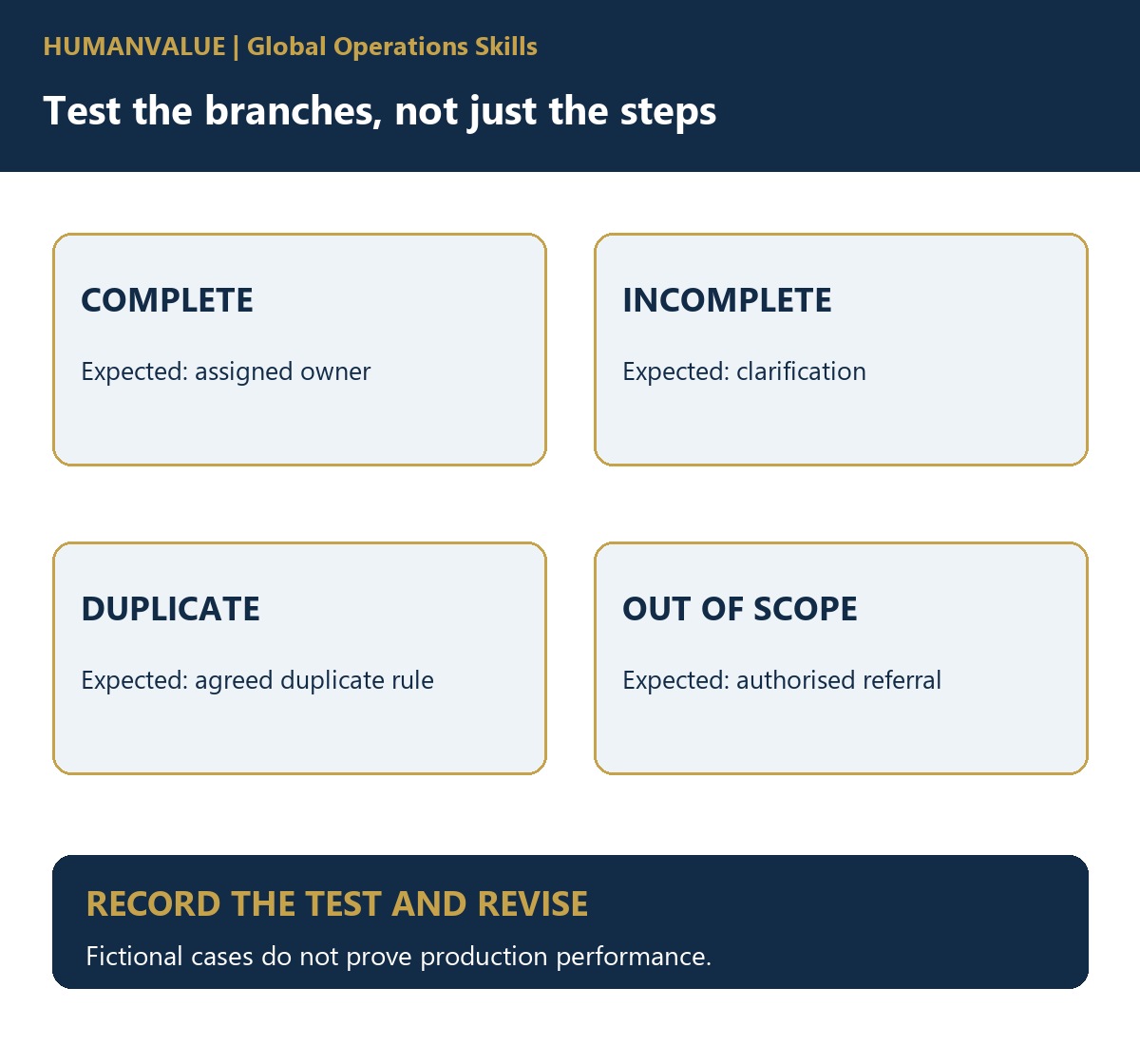
Use several cases with different outcomes. The fictional complete request should reach an assigned owner. The incomplete request should reach a clarification step. The duplicate should follow the defined duplicate-handling rule, and the out-of-scope request should reach the appropriate referral.
Keep the test record proportionate: case identifier, expected result, actual result, issue and revision. Report what you actually tested. Do not claim that four invented cases prove the procedure will work in production or that the process has achieved a measurable business improvement.
Make distributed-team assumptions explicit
International colleagues may work in different time zones and interpret a date such as 04/05 differently. Use an unambiguous date format and specify the time zone when a deadline or handover depends on it. Avoid “end of day” unless the relevant location and meaning are agreed.
Explain internal acronyms and use consistent role names. “Send to the owner” is ambiguous if the document mentions a process owner, case owner and approving manager. A short responsibility key can prevent repeated clarification.
Write instructions in the team’s agreed working language and test whether the intended users understand them. Plain language is useful even for experienced readers. Do not assume that a colleague’s fluent conversation means every technical term or local abbreviation is understood.
Control changes without making the document hard to use
Give the sample a document identifier, version, status, owner and review date. Keep a brief change summary. In a live organisation, approval and publication follow the employer’s process; a portfolio author cannot approve a procedure on behalf of a company.
Identify where the current version is held and how users will know it has changed. If a step changes, consider whether templates, training or linked instructions also need updating. An old downloaded copy can continue circulating after the central document is revised.
A procedure should also explain how users report a problem. If a real exception exposes a gap, record it for review rather than encouraging staff to improvise silently. The owner can then decide whether the instruction or the underlying process needs to change.
Present the sample as evidence of your contribution
A concise portfolio package can include the procedure, fictional test inputs, test log and a short revision note. Explain what you authored, what feedback you received and what you changed. Do not add invented endorsements, employer logos or approval signatures.
In an interview, be ready to explain why you chose the scope, which exception was hardest to describe and what remains untested. If the employer asks for a specific assessment, follow its instructions rather than substituting your existing sample.
Questions remote-operations applicants ask
Must an SOP be long?
No. Length should fit the activity and user need. A short procedure can be useful if it contains the necessary decisions, boundaries and evidence. More pages do not automatically show more competence.
Can AI draft it for me?
You can use a drafting aid where permitted, but you remain responsible for the instructions and claims. Check every step against the fictional process, test the branches and follow the employer’s rules about AI use and confidential information.
Does this sample qualify me for a remote role?
It demonstrates a defined skill when prepared honestly. Employers assess their own requirements, experience and eligibility conditions. A sample is one part of an application, not a credential or job offer.
Connect the sample to your application
For explaining your role in shared work, read our guide to personal contribution in international applications. For handover clarity, use the asynchronous-handover guide.
The HumanValue Learning Center’s CV & Application Pack Lab is relevant to review when organising application materials. If collaborative document work is a development need, compare Microsoft 365 Collaborative Workplace with your requirements. Choose a resource for the actual skill gap, and describe the evidence you produced accurately.