


Research checked: 28 October 2026 | Audience: Tanzania employers, HR teams and recruitment agencies
Quick answer: A Tanzanian employer hiring a customer service representative should define the channels and decisions the role owns, use a short job-relevant simulation, score listening and record accuracy consistently, and set a 30-day coaching plan. A polished interview alone cannot show how a candidate will handle a delayed delivery, angry customer or incomplete CRM record. A practical assessment can, provided it is fair, time-limited and based on fictional customer information.
Why service hiring deserves its own assessment
Customer service roles span retail, logistics, transport, financial services, healthcare, hospitality and technology. The required skills differ. A WhatsApp-first e-commerce operator may need concise written Swahili, accurate order verification and escalation judgement. A bank contact centre may need stronger identity verification, regulated disclosure and careful audit trails. An industrial parts distributor may prioritise technical order numbers and dispatch coordination.
The ISO 18295-1 customer contact centre standard describes a service and performance framework across contact channels. This article does not claim every Tanzanian employer is ISO-certified or legally required to implement that standard. It uses the principle that customer outcomes, process controls and measurable service quality belong together.
Step one: Write the customer promise before the job advert
Ask the service manager to complete one sentence: “Within this role, customers should reliably receive ___ within ___, and unresolved issues must reach ___.” Then identify five to seven actual tasks: verify customer identity where necessary, capture issue details, use approved response templates, check order or ticket status, resolve authorised requests, escalate exceptions and close the loop.
Specify languages based on genuine customer needs. For example, Swahili may be essential for a local retail operation, while English may be needed for certain international accounts. Test both only where relevant; do not reject otherwise qualified applicants on unrelated accent or personal-background preferences. Define shift requirements, accessible workplace arrangements, equipment, reporting line and any sector-specific checks.
Step two: Use a 30-minute, four-part work sample
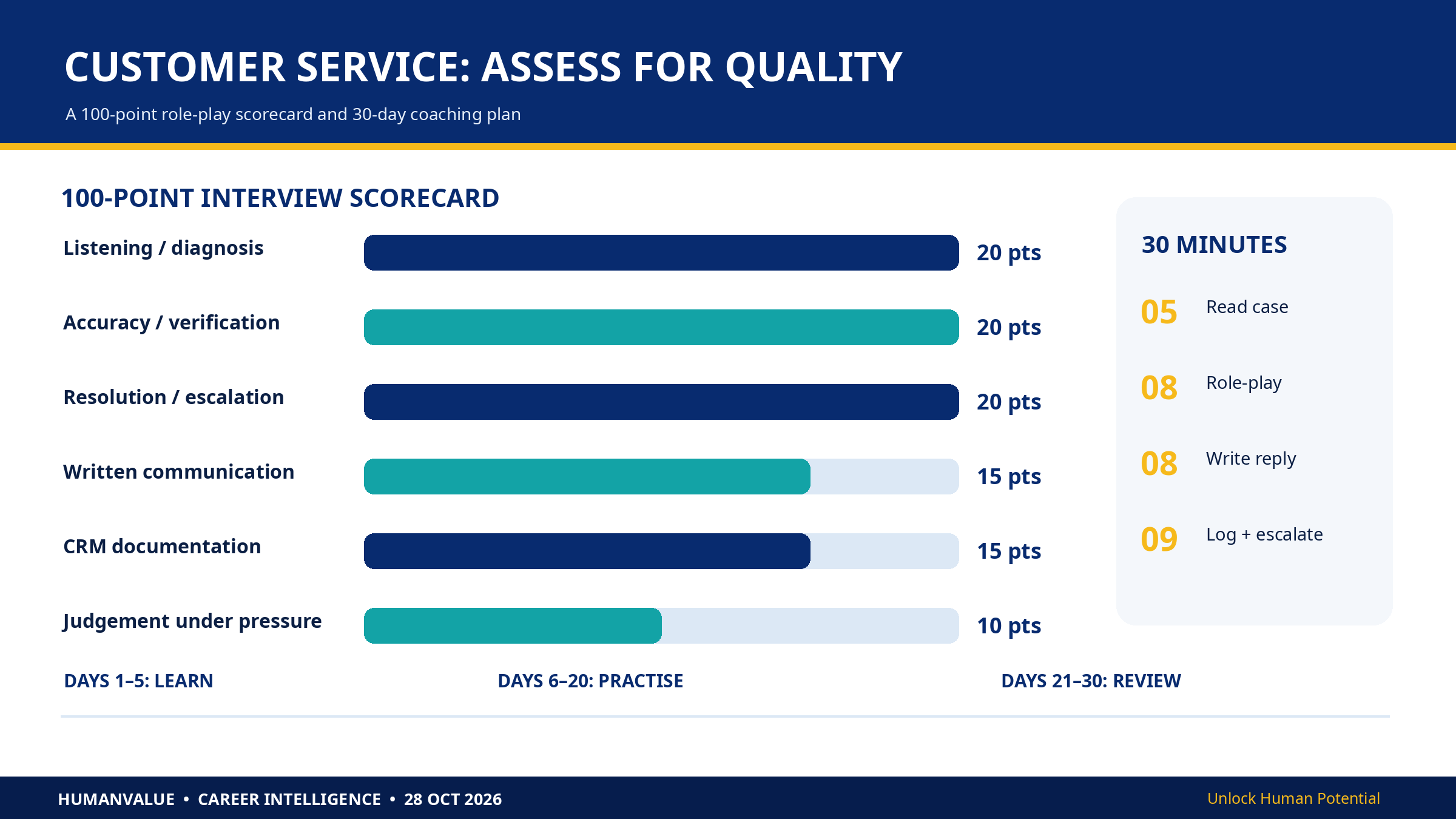
Minutes 0–5: Read the case. Give every candidate the same fictional scenario: a customer ordered a water pump, received a tracking message but no delivery, and is upset because installation is delayed. The case contains a fictitious order number, timeline and company escalation policy. No actual customer data is shared.
Minutes 5–13: Role-play the call. The assessor plays the customer. Look for an appropriate greeting, listening without interruption, a summary of the issue, calm acknowledgement, clear next steps and a commitment that does not exceed company authority. Avoid rewarding exaggerated apologies without practical action.
Minutes 13–21: Write a WhatsApp or email reply. Ask the candidate to communicate what is known, what must be checked, when an update can reasonably be provided and what contact channel will be used. Assess clarity and factual discipline, not just grammar.
Minutes 21–30: Record and escalate. Give the candidate a mock CRM form. Ask for the issue category, relevant dates, verification completed, next owner and follow-up deadline. One intentional contradiction in the case tests whether the candidate notices it instead of silently copying it.
This exercise is for evaluation, not unpaid productive customer work. Provide reasonable adjustments and a consistent alternative format where required. Keep the exercise short enough to respect candidates' time.
The 100-point hiring scorecard
Score the same dimensions for each candidate: listening and issue diagnosis (20 points), accuracy and verification (20), appropriate resolution and escalation (20), written communication (15), CRM documentation (15) and professional judgement under pressure (10). Use anchored definitions: a 4/5 on verification means the candidate checked the correct details before making a claim; a 1/5 means they promised an outcome without checking.
A hiring panel should calibrate scores before interviewing. Review one example answer together, then score candidates independently before discussing differences. For a regulated business, mandatory compliance failures may override a strong total score, but that rule must be defined before assessments begin.
Do not let the role-play become a popularity contest. Confidence is useful, yet a quiet candidate who listens, checks records and communicates accurately may outperform someone who speaks fluently but invents answers.
Example: choosing between two fictional applicants
A Dar es Salaam distributor assesses Asha and Baraka for a service desk role. Asha is personable and reassures the caller that the pump “will definitely arrive today,” although the case contains no delivery confirmation. Baraka asks for the order reference, confirms the tracking discrepancy, records an escalation and promises an update after checking with dispatch. Asha may score higher on warmth, but Baraka demonstrates safer customer promises and a traceable next action.
The lesson is not that empathy is unimportant. Good service combines empathy with accuracy. The employer can coach tone more easily than it can repair a culture of false assurances and missing records.
Step three: Design a 30-day onboarding plan
Days 1–5: Learn the service map. Introduce products, frequent issues, approved channels, escalation rules, customer verification, data handling and system permissions. Let new hires observe good examples and practise with fictional tickets before accessing live records.
Days 6–10: Supervised interactions. Give a small, low-risk queue and review each completed ticket. Provide immediate feedback on fact checking, issue classification and the next-action field. Measure error types, not just speed.
Days 11–20: Expand scope gradually. Assign more varied cases and one documented escalation each day. Audit a sample of conversations for clarity, accuracy and closure. Encourage agents to flag unclear policies rather than improvise.
Days 21–30: Review quality and coaching needs. Compare a balanced scorecard: quality-assurance score, reopened tickets, follow-up timeliness, verified first-contact resolution where applicable, and customer feedback. Avoid using average handling time alone: rushing a call can create a repeat contact.
These are suggested management checkpoints, not statutory probation rules. Employment contracts, pay, hours and any probation arrangement must comply with applicable Tanzanian law and the role's circumstances.
Data protection is a hiring and operations issue
Candidates should not be asked to demonstrate with real customer phone numbers, bank details or medical information. Use fictional records, restrict access to assessments and set retention periods. For live work, grant only the system permissions needed for the role and train staff to verify identity before disclosing account details. The Tanzania Personal Data Protection Commission provides official guidance; employers should check the Personal Data Protection Act, 2022 and applicable rules for their use case.
A well-run recruitment process also avoids collecting unnecessary candidate information. Record why each score was assigned and make the hiring decision on job-related evidence. Keep interview notes securely rather than circulating CVs and customer simulations through personal WhatsApp groups.
Where to source candidates without wasting the budget
Choose the route based on urgency and search capacity. The current JobsTanzania pricing page lists Single Job at TZS 20,000, Employer Monthly at TZS 79,000 per 30 days and Employer Annual at TZS 690,000. The page lists different Talent Bank profile-unlock allowances for subscription plans; review the live plan before paying.
Employers who prefer to search before advertising can use the HumanValue Talent Bank. Its public catalogue lists a one-time seven-day free trial with anonymised previews and up to three unique candidate unlocks. The separate Talent Search plan is TZS 40,000 for 30 days with up to 50 unique candidate unlocks and does not include job posting. Availability, qualifications and consent must be confirmed with each candidate; a profile is not a verified placement.
For high-volume service teams, multilingual support or sensitive hiring, HumanValue recruitment services can be approached for a scoped sourcing, assessment or onboarding proposal. No fixed placement fee is asserted here because the service should be quoted for the assignment.
A decision-ready recruitment brief
Before posting, record: customer channels; weekly case volume if known; language needs; working hours and location; five core competencies; approved salary range; supervisor; required software; privacy and verification controls; role-play scorecard; interview panel; and intended start date. Distinguish non-negotiable legal or safety requirements from skills that can be taught.
A small employer can run this process with one manager and one independent reviewer. A larger contact centre can use it to compare teams and identify training gaps. In both cases, the objective is a customer-service hire who can make the next right decision and document it.
Frequently asked questions
Is a role-play fair for inexperienced applicants?
Yes, if the scenario matches entry-level duties, instructions are clear, scoring is consistent and the exercise does not require insider knowledge that only experienced staff possess. Give candidates a chance to explain their reasoning.
Should we recruit for Swahili and English together?
Only if the actual role needs both. Specify which customer interactions require each language and assess those interactions directly rather than using a generic fluency label.
Does the Talent Bank trial guarantee three suitable candidates?
No. The trial provides eligible unlock capacity, not a promise that three suitable and available people exist for a particular vacancy.
Which KPI should a new service agent improve first?
Prioritise accurate verification, correct escalation and complete records before pushing speed. Add resolution and productivity measures once the agent can handle the process safely.
Sources and editorial note: ISO 18295-1; Tanzania Personal Data Protection Commission; JobsTanzania employer pricing; Talent Bank. All cases, scores and onboarding intervals are illustrative HumanValue editorial frameworks, not claims about real candidates or employers.