


HumanValue Employer Intelligence | Tanzania | Researched 8 November 2026
When hiring an HR assistant, assess whether the candidate can organise records, identify uncertainty and protect information while following a defined process. A neatly labelled folder is useful, but it does not prove that its contents are current, complete or available only to the right people.
For Tanzanian employers, the role may support recruitment administration, onboarding, leave records or employee correspondence. Define the responsibilities before choosing the assessment. This guide provides an original fictional file-review exercise and an employer framework; it is not a legal audit or a validated professional examination.
Decide what the assistant will own and what needs approval
An HR assistant can maintain an index, prepare a query list and follow up missing information without being authorised to decide employment terms or disclose a personnel file. Separate administrative preparation from approvals, professional advice and management decisions.
Write the reporting line, systems used and essential entry skills. If the employee will handle onboarding, explain who confirms the approved offer and starting arrangements. If the role supports payroll inputs, define the review and approval route rather than allowing a hiring exercise to imply that the assistant independently decides pay.
| Responsibility | What to assess | Boundary to clarify |
|---|---|---|
| File indexing | Accurate references and a usable document list | An index is not proof of legal completeness |
| Record checking | Identification of missing or conflicting information | No invented signature, date or approval |
| Follow-up | A precise query with an owner and next step | Use the approved contact and escalation route |
| Confidentiality | Information limited to the recipient’s need | Access depends on role and authorisation |
| Reporting | A clear summary of confirmed and unresolved items | Refer decisions to the responsible professional or manager |
Use invented records for candidate assessment
Prepare a small fictional file pack with employee codes rather than real names. Include an index, an approved example document, a draft with no approval and a record whose date conflicts with the supplied source. Provide a written exercise policy explaining which documents are expected and who can authorise corrections.
Do not give candidates live personnel files to see whether they can “be discreet”. That exposes information unnecessarily and can make the assessment harder to control. A well-designed fictional pack can test the same administrative judgement.
The Personal Data Protection Act published by Tanzania’s PDPC includes principles covering accuracy, purpose, necessary scope and appropriate security. These principles make careful record handling relevant. They do not turn this sample checklist into a complete statement of an employer’s legal obligations.
A fictional file review with three different findings
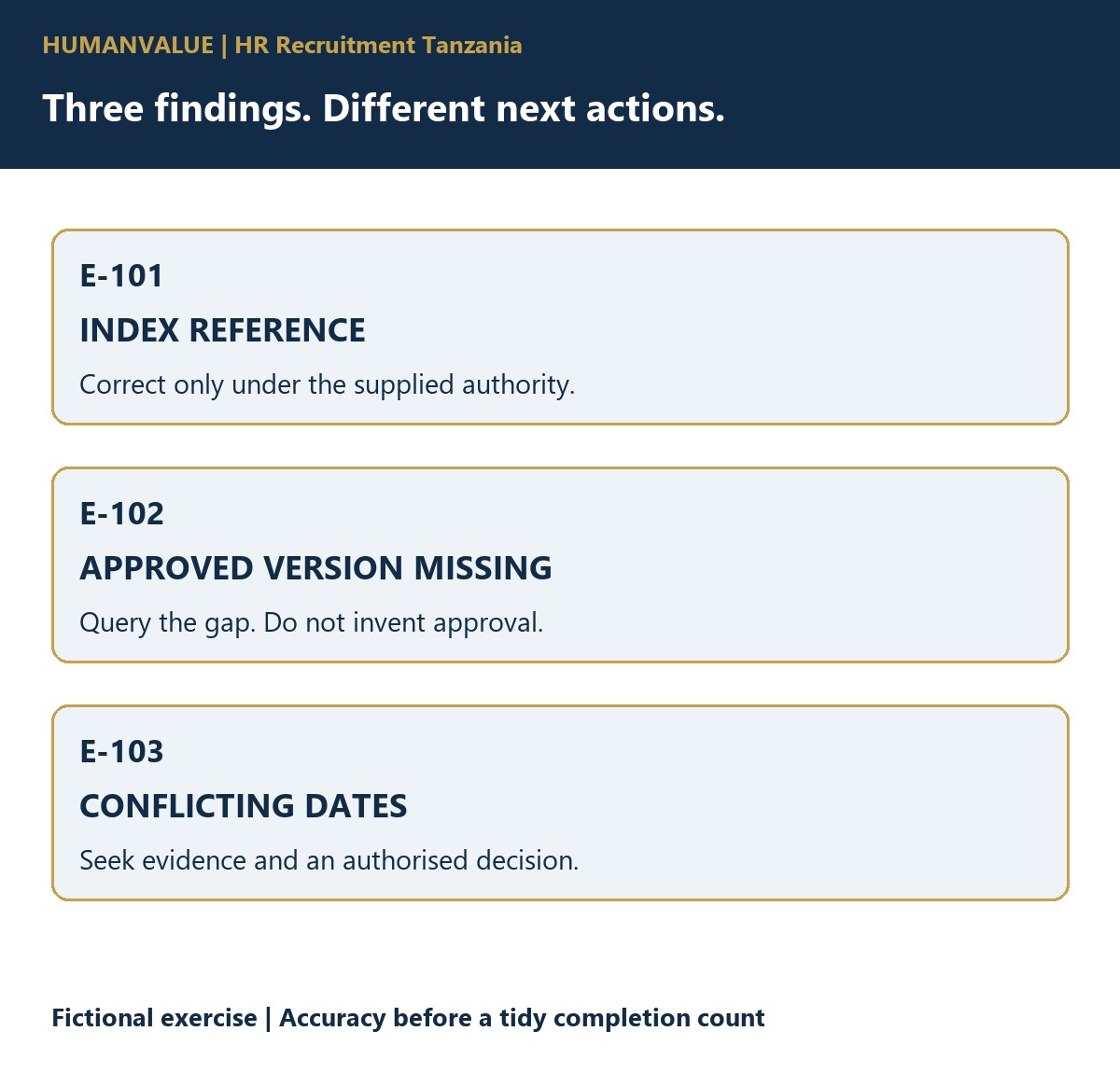
In the exercise, file E-101 contains the expected approved document but its index reference is wrong. File E-102 contains a draft where the supplied policy expects an approved version. File E-103 has two conflicting dates, with no instruction identifying which is authoritative.
Ask the candidate for a corrected index where permitted, a query log and a short update to the HR manager. The candidate should not treat all three findings as the same kind of error. An index reference may be correctable under the supplied rules. A missing approval cannot be created by the assistant. Conflicting dates need evidence and a decision route.
Fictional HR update: “E-101’s index reference has been corrected under the exercise instructions. E-102 contains a draft; the required approved version has not been confirmed. E-103 has conflicting dates and needs an authorised review. The query log identifies the evidence and decision needed for each open item.”
All employee codes and findings in this example are invented. The exercise’s document requirements come from its fictional policy, not from a claim that these are the only documents every Tanzanian employer must hold.
Score the reasoning behind the output
Decide the rating criteria before assessment. Look for accurate classification, traceable references, clear follow-up and respect for authority. Avoid rewarding a candidate for making every row appear complete if the evidence does not support that result.
| Dimension | Evidence of a stronger response | Concern to explore |
|---|---|---|
| Accuracy | Findings match the supplied pack | Invented approval or unsupported correction |
| Traceability | Every finding cites a file and source | A broad “files incomplete” statement |
| Judgement | Correctable errors and unresolved decisions remain distinct | Changes made beyond the supplied authority |
| Communication | Queries identify the gap and next decision | Long narrative without an action request |
| Discretion | Only necessary fictional details are repeated | Unnecessary sharing or requests for real employee data |
Pilot the task with someone who understands the role and check whether the instructions are clear. Give candidates equivalent materials, time and tool access, with appropriate adjustments. Assessors should record their observations before discussing the result.
The US OPM’s work-sample guidance supports using tasks that resemble the actual job. Its discussion is an assessment-design reference, not Tanzanian employment law or independent validation of this exercise.
Ask interview questions that test real follow-through
Ask for a genuine example of resolving an incomplete record. What did the candidate check, who had authority and how was the outcome recorded? If the applicant is new to HR, a clearly labelled academic or practice example can show reasoning, but should not be presented as employment experience.
Explore how the candidate would respond to a manager requesting a whole file when only one item is needed. Look for recognition of the approved access and disclosure process. Avoid asking candidates to disclose confidential cases from previous employers to make their answer more convincing.
Induction should teach the employer’s actual controls
Show the appointed assistant the file structure, authorised access, naming conventions, approved templates and query process. Explain who can change records and how those changes are documented. Provide a route for asking questions without pressuring the employee to make unsupported assumptions.
Start with supervised review of a defined set of records. Check whether the index is usable and whether unresolved items reach the right person. Record improvement needs separately from decisions about legal compliance, which may require a qualified review.
Questions employers ask
Does a file audit prove that the candidate knows labour law?
No. This task assesses specified administrative capabilities. If legal knowledge is essential to the role, define and assess it separately with appropriate expertise.
Should a candidate fix every problem during the assessment?
Only within the fictional instructions and evidence. Recognising when a correction needs approval can be a stronger response than making an unsupported change.
Can real documents be anonymised for the exercise?
Prefer fully invented materials. Removing names alone may leave identifying facts or sensitive details. Use an approved process if any actual material is considered.
Agree the recruitment brief with HumanValue
For HumanValue HR and recruitment support, explain the role’s scope, essential skills, systems and reporting responsibilities. Agree whether support includes sourcing, screening, assessment design or interview coordination, together with deliverables, employer responsibilities, timing and fees. Do not assume that recruitment support includes a legal audit or a guarantee of future performance.
For panel consistency, use our interview-scorecard calibration guide. For practical collaboration development, review Microsoft 365 Collaborative Workplace against the actual need. For corrections, read the Kiswahili record-history guide.
Editorial contact: Emily Sebashahu
HR Services & Recruitment Director, HumanValue Consulting Limited.
Follow Emily on LinkedIn for HR and recruitment insights.