


HumanValue Employer Intelligence | Tanzania | Researched 8 November 2026
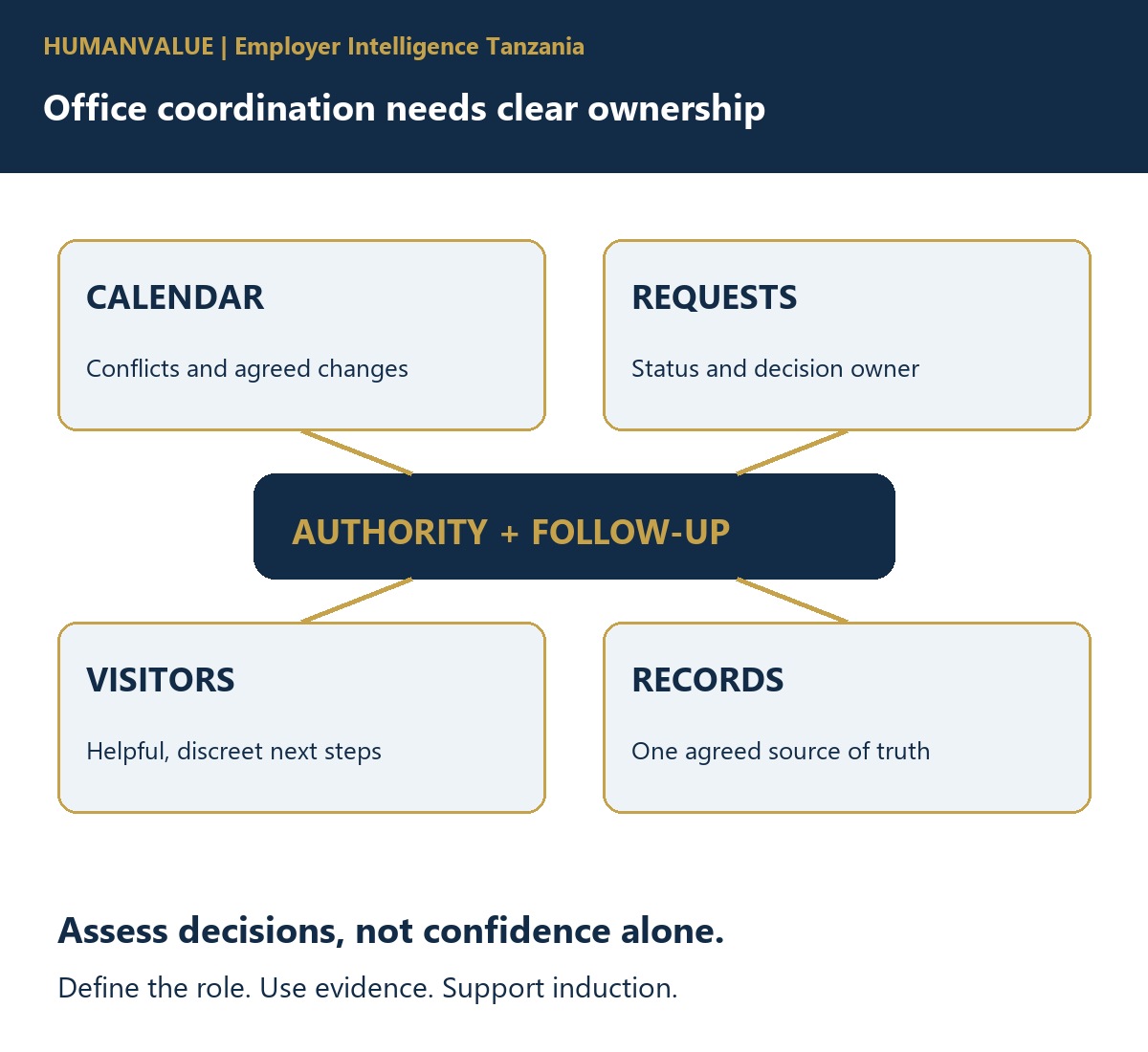
Hire an office administrator for the decisions and coordination your office actually needs. A friendly welcome matters, but the role may also involve calendars, supplies, documents, service providers and unresolved requests. Assess those responsibilities directly instead of choosing solely on confidence, appearance or the ability to describe a busy day.
For a Tanzanian employer, the first hiring question is practical: what must keep working when the office becomes busy? This guide helps turn that answer into a recruitment brief, a manageable assessment and an induction plan. The examples are fictional and should be adapted to the actual job.
Define the role around work that must be owned
An office administrator in a small business may coordinate several functions. In a larger organisation, reception, procurement, facilities and executive support may be separate roles. Describe the boundaries rather than placing every unfinished administrative task into one vacancy.
Identify the reporting manager, expected working arrangements, essential systems and approval limits. Distinguish routine coordination from decisions about expenditure, access, contracts and confidential records. If the role supports more than one manager, agree how conflicting priorities will be resolved before the new employee starts.
| Current problem | Responsibility to define | Evidence to request |
|---|---|---|
| Meeting arrangements change without notice | Maintain the approved calendar and communicate changes | A clear conflict-resolution message |
| Supply requests lack follow-up | Track requests through the authorised process | A register showing status, owner and next action |
| Visitors receive inconsistent guidance | Follow the agreed reception and access process | A discreet, helpful service response |
| Files have several competing versions | Maintain the agreed document location and references | An explanation of how the official record is identified |
| Managers cannot see unresolved work | Provide an accurate pending-action summary | A concise update separating facts and decisions |
Choose an assessment that resembles the work
The US Office of Personnel Management’s work-sample guidance describes exercises that mirror job tasks and are assessed through observed behaviour or outputs. That is a useful design principle. It does not validate this proposed exercise or make US federal recruitment rules applicable to a Tanzanian employer.
Use a short fictional office inbox with a calendar, a supply request and a visitor enquiry. Give candidates the same instructions, approval rules and tools. Tell them what outputs you want and how much time they have. Pilot the exercise to check that the time allows thoughtful work and that the instructions do not create accidental traps.
If a particular software skill is essential on entry, assess it with an appropriate task. If the organisation will train the employee on a proprietary system, avoid making unfamiliar buttons the main barrier. Separate the ability to organise work from prior exposure to your specific software.
A fictional inbox case with three competing requests
In the exercise, a meeting room is booked for a team review. A client-facing manager requests the same room at the same time, but no priority rule has been supplied. A stationery request is awaiting approval. A visitor arrives for an employee whose availability has not been confirmed.
Ask the candidate to prepare an action list and two short messages. A strong candidate identifies the calendar conflict and asks for the relevant decision rather than cancelling someone else’s booking without authority. They keep the stationery request visible without claiming an order has been placed. They welcome the visitor and contact the authorised host without disclosing internal diary details unnecessarily.
Fictional scheduling message: “The room is already booked for the team review at the requested time. I have not changed either arrangement. Please confirm which meeting has priority, or whether I should check another room or time. I will update both organisers once the decision is agreed.”
The assessment is not a test of whether the person guesses the manager’s preferred answer. It is a test of whether they recognise a dependency, communicate options and act within the supplied authority.
Record evidence rather than impressions
| Dimension | Weak evidence | Stronger evidence |
|---|---|---|
| Prioritisation | Acts on the loudest request without checking impact | Explains urgency, dependencies and decisions needed |
| Accuracy | Marks unapproved work complete | Uses statuses supported by the supplied information |
| Service | Makes a promise outside the role’s authority | Offers a helpful next step with realistic limits |
| Communication | Sends a long account with no request | Names the issue, options and required decision |
| Discretion | Shares internal information unnecessarily | Uses only information needed for the recipient’s task |
Set the rating scale and any essential criteria before the first assessment. Have assessors note what the candidate actually did, then compare ratings. Resolve differences by referring to the evidence, not to statements such as “seemed more professional”. Make the process accessible and discuss appropriate adjustments without changing the competence being measured.
Use the interview to understand judgement over time
Ask for a real example of conflicting requests. What did the applicant know at the start, who made the priority decision and how were affected people informed? Follow up on their own contribution and what they learned. Do not require confidential documents from a former employer as proof.
Explore a second example involving an error or an overdue request. A useful answer explains how the person discovered the problem, corrected the record and kept the work moving. Be cautious about treating an account with no difficulties as automatically stronger than an honest account of a resolved problem.
Set the new employee up to succeed
Induction should provide the office directory, approval routes, calendar rules, document locations and escalation contacts. Explain which promises the administrator may make independently and which require approval. Show how open requests are reviewed and what counts as closure.
Start with supervised responsibility for a defined workflow. Review the accuracy of the records and usefulness of the updates. Expand the remit when the person understands the process. A vague instruction to “take ownership of everything” gives little support when responsibilities conflict.
Questions employers should settle before advertising
Is this a receptionist or an office administrator?
Use the duties to decide. If the role includes substantial purchasing, facilities or executive support, describe those responsibilities and assess them appropriately rather than relying on the title alone.
Should speed determine the result?
Use realistic time demands for the role. A rushed output containing unsupported commitments may create more work than a careful response that identifies a decision promptly.
Can one person support several managers?
Possibly, but the employer needs an agreed priority process, capacity expectations and a reporting line. Recruitment cannot fix a structure in which everyone can override everyone else.
Brief HumanValue on the outcome you need
When discussing HumanValue HR and recruitment services, bring the role’s responsibilities, reporting line, essential skills and the administrative problems you want to resolve. Agree the sourcing, screening, assessment or interview-support deliverables, timing, employer responsibilities and fees before engagement. The employer retains its selection and management decisions.
For staff development, review Microsoft 365 Collaborative Workplace against the actual collaboration gap. For panel preparation, read our hiring-panel calibration guide. For a narrower reception workflow, see the purposeful visitor-log guide.
Editorial contact: Emily Sebashahu
HR Services & Recruitment Director, HumanValue Consulting Limited.
Follow Emily on LinkedIn for HR and recruitment insights.