


HumanValue Employer Intelligence | Tanzania | Researched 8 November 2026
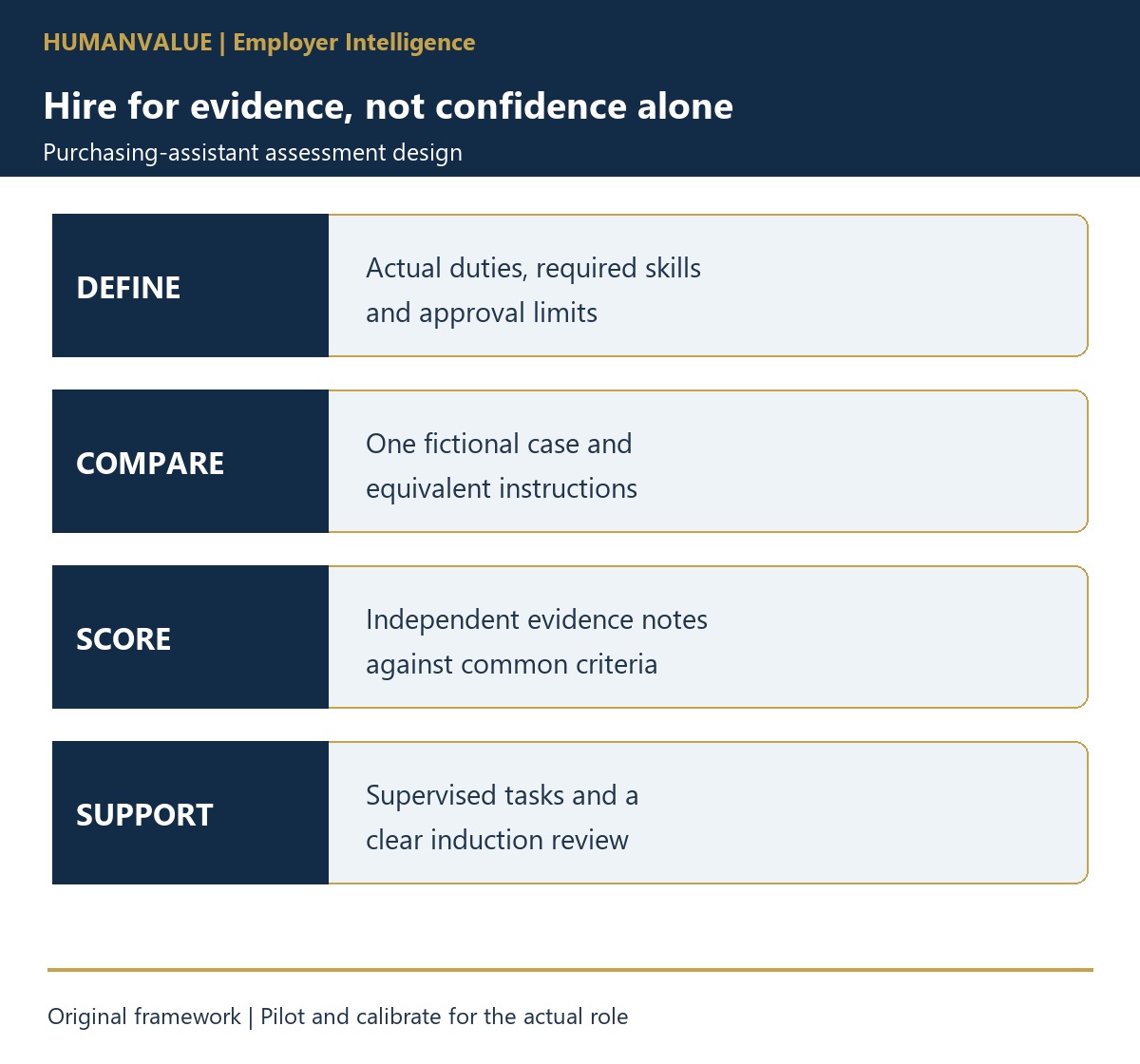
To hire a purchasing assistant in Tanzania, assess whether the candidate can turn an approved requirement into a traceable comparison, recognise missing information and keep approval with the right person. A confident negotiator who quietly changes a specification can create more work than a careful assistant who raises a clear question. Start with the duties and decision limits of your actual role, then test them consistently.
This employer guide combines a fictional assessment, an interview structure and an induction plan. It is intended for ordinary internal hiring design, not as a public-procurement compliance procedure. Sector-specific qualifications, professional requirements and regulated purchasing processes need separate checks. The suggested scoring framework is original teaching material; it has not been validated as a universal hiring test.
1. Define the job you need filled
In a small office, purchasing support may sit with administration. In a distributor, hotel or industrial business, the assistant may coordinate with stores, finance and several requesting departments. The job title alone does not explain whether the person gathers quotations, prepares comparisons, issues approved orders or follows up delivery. Nor does it tell applicants which system they will use or who approves a commitment.
Before advertising, write a responsibility map. Identify the requester, budget owner, purchasing reviewer, authorised approver, receiving role and finance contact. One person may hold more than one role, but that arrangement should be explicit. Ask what the assistant must know on arrival and what will be taught. A test should not penalise applicants for lacking knowledge that your organisation intends to provide during induction.
The US Office of Personnel Management’s work-sample guidance describes assessments based on activities resembling job tasks. It also highlights the importance of matching the method to the competencies required. This is a selection-method reference, not Tanzanian employment law or a substitute for reviewing your local hiring obligations.
2. Separate the shortlist criteria from the practical exercise
| Area | Specify before recruitment | Evidence to seek |
|---|---|---|
| Role scope | Support tasks and decisions reserved for others | A clear explanation of past responsibilities, without confidential documents |
| Required background | Relevant qualification or experience and why it is needed | Consistent, proportionate verification |
| Records and systems | Actual spreadsheet or purchasing-system duties | A fictional comparison that can be checked |
| Communication | Who receives questions, updates and exceptions | A concise clarification message |
| Integrity and approval | Conflict reporting and authorised commitments | Recognition of a decision outside the assistant’s authority |
Apply the advertised requirements consistently. A polished CV is useful for identifying relevant experience, but it does not prove that a person can reconcile a quantity or explain an assumption. Ask candidates to describe work they actually performed. Do not request supplier lists, negotiated prices or internal documents from previous employers.
3. Give every candidate the same fictional case
Use a 40-minute exercise as a proposed starting point, then pilot the timing. Explain the format and make appropriate assessment arrangements through your hiring process. Give the same requirement, quotations, calculator or spreadsheet access, instructions and clarification route to every candidate.
The fictional requirement is 24 identical desk lamps for an office project, delivered to one stated location. Supplier A quotes for 24 specified units with delivery shown separately. Supplier B offers a lower unit price but a different model. Supplier C matches the specification but leaves delivery timing and tax treatment unclear. Invent the documents yourself; the task is about reasoning, not knowledge of current market prices.
Ask the candidate to prepare a comparison, write two supplier questions and give the purchasing reviewer a short update. A good answer should flag that B is not yet comparable, keep C’s unknown terms visible and avoid recommending an order before material questions are resolved. Do not build a hidden answer that rewards choosing the lowest price regardless of specification.
Fictional reviewer update: “The three offers are not yet comparable. B proposes a different model; C has not confirmed delivery timing or tax treatment. Please confirm whether alternatives may be considered. I have prepared clarification questions and will update the comparison when authorised responses arrive.”
4. Score the evidence, including the questions raised
Give assessors an answer guide before the first applicant attends. It should show the material differences in the case, acceptable ways to record uncertainty and the role’s authority limits. The CIPS procurement glossary is a useful reference for terms such as requisition and purchase order. Use your organisation’s actual approved documents to explain the real workflow during induction.
| Criterion | Points | Observable evidence |
|---|---|---|
| Requirement and specification | 25 | Different model is identified rather than treated as equivalent |
| Arithmetic and traceability | 20 | Quantities, units and stated costs can be followed back to the case documents |
| Unknown terms | 20 | Missing timing and tax information remains explicitly unresolved |
| Communication | 20 | Questions are specific and the reviewer can see what decision is needed |
| Approval and integrity | 15 | No unsupported commitment; a conflict or instruction outside authority is raised |
Have assessors record a short example beside each rating before discussing the overall candidate. A candidate who spots a missing term should not lose points for refusing to manufacture a number. Where assessors disagree, examine the evidence and the instruction, rather than simply averaging confidence. Adjust ambiguous questions before using the assessment again.
5. Use the interview to understand ownership
Ask every candidate a consistent core of job-related questions. For example: “Tell us about a time you found a mismatch in a request or quotation. What did you check, what could you decide and what did you refer?” Follow up on the person’s own actions. A team result is not automatically evidence that the applicant performed every step.
The OPM structured-interview guidance supports using predetermined questions and common rating standards. For your panel, agree what a complete answer contains and allow neutral clarification. Compare the interview evidence with the exercise; investigate contradictions rather than ignoring them because a candidate speaks fluently.
6. Make the first month a controlled transition
In the first week, explain the approved request, quotation, approval and receiving workflow using fictional or appropriately controlled training records. In the next stage, supervise a limited set of real tasks within the person’s authority. Review the quality of questions, comparisons and follow-up notes before expanding responsibility.
Do not judge induction solely by how quickly orders are processed. Look for traceable records, material terms checked before approval and exceptions sent to the right owner. Use the HumanValue quotation-comparison learning exercise as supplementary practice. For spreadsheet development, check the contents of Workplace Excel Essentials in Tanzania against the actual skill gap.
7. Frequently asked questions
Should the lowest-price recommendation receive the highest score?
Only when it follows the stated requirement and adequately addresses the relevant terms. In this fictional case, comparability is unresolved. The candidate should explain what must be clarified before a recommendation is complete.
Can we use a real pending purchase as the test?
Prefer an invented case that resembles the work. It protects commercial information and avoids turning candidate assessment into unpaid production work. Keep the exercise proportionate and assess the same evidence across candidates.
Is the scorecard a professional certification?
No. It is a proposed employer assessment design. It does not replace qualification checks, applicable professional requirements, reference verification or the employer’s hiring responsibilities.
8. Bring HumanValue a specific recruitment brief
If you need purchasing support, describe the workflow problem as well as the vacancy: incomplete comparisons, unclear ownership or weak delivery follow-up may require different experience and induction. HumanValue can discuss sourcing, screening and relevant assessment support through its HR and recruitment services. Agree the deliverables, responsibilities, timing and fees before work begins. No assessment can guarantee future performance.
If you are recruiting directly, publish the vacancy on JobsTanzania with the real duties and requirements. Before interviews, read how to calibrate a hiring-panel scorecard.
Editorial contact: Emily Sebashahu
HR Services & Recruitment Director, HumanValue Consulting Limited.
Follow Emily on LinkedIn for HR and recruitment insights.