


|
QUICK ANSWER |
Introduction
A job description is not simply an internal HR document. It is the first operating agreement between a hiring manager, the recruitment team and a potential applicant. When the document is vague, the employer receives applications that are difficult to compare. When it is specific and honest, applicants can judge fit and the selection team can use consistent evidence.
In Tanzania, employers recruit across different locations, sectors, education routes and levels of formality. A useful job description therefore needs local context without making unsupported labour-market claims. State the actual duty station, travel expectations, language needs, employment arrangement and application method. Where a role is regulated, verify current professional registration, licensing or statutory requirements with the responsible authority before publication.
For market context, the National Bureau of Statistics Labour and Employment Reports page lists official Tanzania labour publications, including the Formal Sector Employment and Earnings Survey 2024–25 dated 21 July 2026 and Labour Market Key Findings from the ILFS 2025 dated 15 July 2026.
Why a Clear Job Description Matters in Tanzania
|
Employer need |
What the job description should provide |
Decision benefit |
|
Relevant applications |
Clear purpose, duties and essential requirements |
Applicants can self-assess before applying |
|
Fair comparison |
Role-related criteria stated before selection |
Reviewers use the same evidence standard |
|
Faster screening |
Required documents and application channel are explicit |
Fewer avoidable follow-up questions |
|
Stronger retention foundation |
Realistic account of work, location and expectations |
Reduces mismatch after appointment |
|
Employer credibility |
Accurate dates, contacts and conditions |
Builds trust without inflated promises |
|
LOCAL CONTENT RULE |
The Eight-Part JobsTanzania Job Description Framework
1. Job identity
Job title, department, duty station, employment arrangement and reporting line.
2. Job purpose
One or two sentences explaining why the role exists and the result it should create.
3. Key outcomes
Five to eight responsibilities written as accountable outcomes, not a list of vague activities.
4. Essential requirements
Only the knowledge, experience, qualifications and licences genuinely required on day one.
5. Preferred requirements
Useful differentiators that should not be presented as mandatory.
6. Success measures
A short description of how performance will be assessed during the initial period.
7. Employment information
Working pattern, travel, physical or site requirements and compensation only where approved.
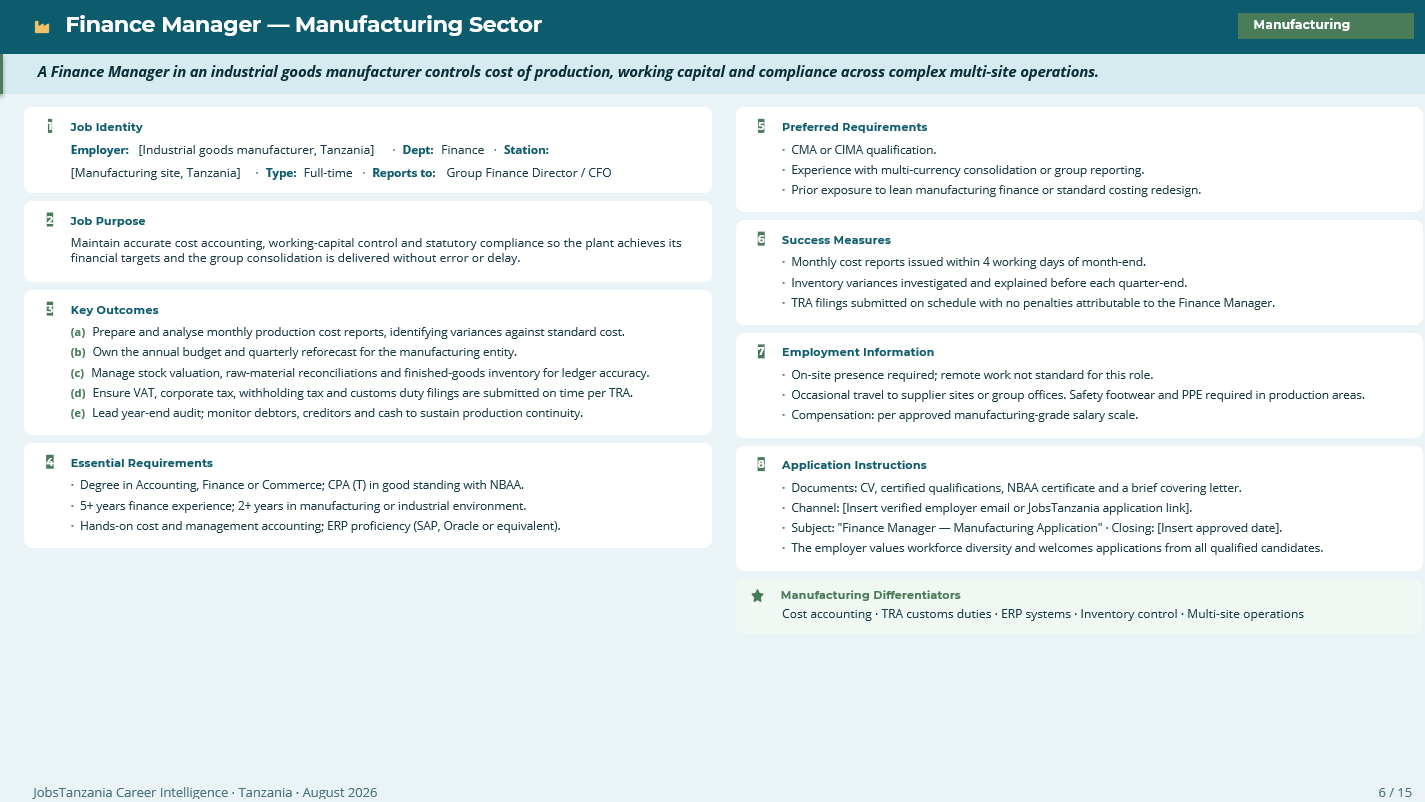
Access ready-to-use job description templates designed for different industries and roles. Make your vacancies clearer, more professional, and more attractive to the right candidates.
Click here to access the 15-slide presentation and explore the JD templates.
8. Application instructions
Documents, method, closing date, contact channel and a truthful equal-opportunity statement.
A Step-by-Step Writing Method
Step 1: Start with the business outcome
Ask the hiring manager to complete this sentence: “This role exists to…” The answer should describe a business, customer, operational or service result. If the sentence only says “support the department,” ask what better outcome the support should create.
Step 2: Convert activities into accountable responsibilities
Use an action, an object and a purpose. Example: replace “handle support tickets” with “resolve and document assigned support incidents within agreed service targets so employees can resume work safely.” The employer should insert only targets that have been formally approved.
Step 3: Separate essential from preferred
An essential requirement should have a clear reason. If the selection panel cannot explain why the requirement is necessary to perform the job, move it to preferred or remove it. Avoid using years of experience as a substitute for evidence of capability.
Step 4: Add local operating context
· State the correct duty station and whether travel is required.
· State language requirements only where the work genuinely needs them.
· Identify shift, site, field or remote arrangements accurately.
· Name regulated qualifications or registrations only after verification.
· Use Tanzanian shillings and an approved pay basis if compensation is disclosed.
Step 5: Build selection criteria from the document
For each essential requirement, define what evidence will be accepted in the application, screening, assessment or interview. This makes the job description useful throughout the selection process rather than only at advertising stage.
Step 6: Review from the applicant’s perspective
A person unfamiliar with the organisation should be able to explain the purpose, essential requirements, work location, application method and next action. Remove internal abbreviations and phrases such as “other duties as assigned” where they conceal the real scope.
Local Context and Compliance Checks
Tanzania’s Employment and Labour Relations Act, Chapter 366 provides for core labour rights, basic employment standards, collective bargaining and dispute prevention and settlement. The version shown by TanzLII is dated 14 March 2025.
This article is practical content guidance, not legal advice. The Act’s table of contents includes prohibition of discrimination in the workplace, employment standards, contracts with employees and written statements of particulars. Employers should obtain qualified legal or HR review where wording may create legal, regulatory, safety or contractual risk.
· Do not specify personal characteristics unless a lawful, role-related requirement has been verified.
· Keep vacancy wording consistent with the approved position, contract and selection criteria.
· Confirm current professional registration and licensing directly with the responsible body.
· Protect applicant information and restrict access to those involved in recruitment.
· Avoid guarantees about employment, promotion, earnings or selection outcome.
Common Mistakes and Practical Fixes
|
Common mistake |
Why it weakens the vacancy |
Practical fix |
|
Generic title |
Applicants cannot judge level or function |
Use a recognised title and add a specialist qualifier only when needed |
|
Long company introduction |
The role is buried below marketing copy |
Keep the employer summary concise and move the job purpose near the top |
|
Twenty-plus duties |
Accountability becomes unclear |
Prioritise five to eight outcomes and group related activities |
|
Everything is essential |
Qualified applicants may self-select out |
Separate day-one requirements from trainable preferences |
|
Undefined “competitive salary” |
The phrase provides no decision evidence |
Publish approved information or omit the claim |
|
No success measures |
Applicants cannot understand performance expectations |
Give two to four role outcomes without inventing targets |
|
Weak application steps |
Applications arrive incomplete or through unsafe channels |
Specify documents, official channel and closing date |
Sample Well-Written Job Description
|
SAMPLE USE NOTICE |
ICT Support Officer, Dar es Salaam
|
Field |
Sample content |
|
Employer |
Mwangaza Services Tanzania Limited (fictional example) |
|
Department |
Information and Communication Technology |
|
Duty station |
Dar es Salaam, with occasional approved travel to branch locations |
|
Reports to |
ICT Manager |
|
Employment arrangement |
Full-time; final contract terms subject to employer approval |
|
Application deadline |
[Insert approved date and time] |
|
Application channel |
[Insert verified employer email or JobsTanzania application link] |
About the Employer
Mwangaza Services Tanzania Limited is a fictional Tanzania-based service company used only to demonstrate clear vacancy writing. Replace this paragraph with a verified, concise description of the real employer, customers and operating context.
Job Purpose
The ICT Support Officer will restore employee technology services, maintain accurate support records and help reduce repeat incidents through structured troubleshooting, user guidance and controlled escalation.
Key Responsibilities
· Receive, classify, troubleshoot and document assigned user incidents and service requests through the approved support channel.
· Resolve supported hardware, software, account and connectivity issues within approved procedures and escalate issues that exceed assigned authority.
· Maintain accurate asset, resolution and handover records so that support history and ownership remain traceable.
· Prepare simple user guidance for recurring issues and deliver approved awareness sessions where requested.
· Support approved device setup, updates and access changes while following security, privacy and change-control requirements.
· Review recurring incidents and submit a monthly summary of causes, actions and recommended preventive improvements to the ICT Manager.
· Coordinate with approved service providers and internal teams, recording commitments, status and closure evidence.
· Participate in approved continuity tests and maintain current support contact and escalation information.
Essential Requirements
· Diploma or degree in information technology, computer science or a related discipline from a recognised institution.
· Demonstrable experience troubleshooting end-user devices, common business applications, user accounts and basic network connectivity.
· Ability to document incidents, explain technical steps in plain language and work through an agreed escalation path.
· Ability to handle access and user information confidentially and follow approved security procedures.
· Working proficiency in English and Kiswahili where required for the verified user environment.
Preferred Requirements
· Relevant entry-level technical certification.
· Experience with a structured service desk or ticket-management process.
· Experience supporting users across more than one location.
What Success Looks Like
· Assigned incidents have complete records, clear ownership and timely status updates.
· Users receive understandable guidance and confirmed closure.
· Recurring issues are identified and supported by evidence.
· Devices, access changes and escalations follow approved controls.
How to Apply
Submit a CV and a short cover note explaining one relevant support example through [insert verified channel] by [insert approved deadline]. Use the subject line “ICT Support Officer Application”. Do not include information that the employer has not requested. Only shortlisted applicants will be contacted if that statement reflects the employer’s approved process.
Employer Review Before Publishing
· Replace every bracketed field.
· Confirm title, reporting line, duty station and employment arrangement.
· Verify qualification and language requirements.
· Approve compensation wording, deadline and contact channel.
· Check that selection criteria match the essential requirements.
· Complete legal, privacy and brand review.
Pre-Publication Checklist
· The job purpose describes one clear outcome.
· Responsibilities are specific, grouped and realistically prioritised.
· Essential and preferred requirements are separated.
· Duty station, travel and working arrangement are accurate.
· No salary, benefit, deadline or regulatory claim is invented.
· Application instructions and links have been tested.
· Selection criteria are traceable to the job description.
· Language is plain, inclusive and understandable on mobile.
· A second reviewer has checked facts, consistency and spelling.
· The final vacancy has an accountable owner and response channel.
How JobsTanzania Can Support the Next Step
Publish a vacancy: Post a Job on JobsTanzania using the approved job description and application details.
Reach job seekers: Browse JobsTanzania jobs to review how current opportunities are presented to applicants.
Build employer knowledge: Visit the JobsTanzania blog for recruitment and career guidance.
Related guide: Read the JobsTanzania CV format guide to understand the evidence applicants may present.