


Quick Answer
|
A job description explains why a position exists, its responsibilities and the standard expected from the employee. KPIs turn those expectations into measurable results. A job description alone does not automatically justify a salary increase or promotion, and KPIs do not guarantee either outcome. However, when targets are agreed, adequately resourced, reviewed consistently and linked to a transparent recognition framework, they create stronger evidence for performance decisions. For Tanzanian employers, this means clearer accountability and more defensible people decisions. For employees, it means knowing what success looks like and what evidence to keep. The practical sequence is simple: define the role, agree measurable KPIs, provide the required resources, review evidence regularly and apply the organisation’s approved reward and promotion policy fairly. |
By Emily Sebashahu, HR Services Consultancy Manager at JobsTanzania
Introduction
When an employee is hired, one of the first documents the employee receives is a job description. It explains the role, the main responsibilities and the reason the position exists. In organisations with a weak performance culture, however, the term KPI may remain unfamiliar. Employees mainly hear instructions such as “do this” or “do that”, without a written measure of what good performance means.
I once asked a senior leader in a manufacturing organisation in Dar es Salaam why KPIs were not given priority. The response was that manufacturing was too complex to manage through KPIs, particularly for employees at lower levels. I found that position unfortunate. Even supervisors, officers and managers had worked for years without clear KPIs.
The issue was not that the work could not be measured. The real issue was that the organisation had not translated responsibilities into fair, practical and measurable expectations. That gap affects employees, managers and the business itself.
Without KPIs, There Is No Objective Basis for Salary Change or Promotion
Where KPIs do not exist, employees have a limited roadmap for understanding what to deliver, how performance will be assessed and what evidence may support a salary review or promotion. Decisions can become dependent on opinion, visibility or the strength of a manager’s memory rather than documented results.
A job description normally explains duties. It does not, by itself, show whether the employee met the required quantity, quality, cost, time or service standard. KPIs help close that gap. They do not guarantee an increment or promotion, because those decisions also depend on company policy, affordability, role availability and other approved criteria. They do, however, provide a stronger and fairer basis for discussion.
Absence of KPIs Can Increase Turnover
What happens when performance expectations are unclear? Organisations may experience repeated underperformance meetings, disagreements about fairness, employees visiting HR with compensation concerns and growing dissatisfaction.
Frequent employee replacement is costly. New employees need time to learn the work, understand the culture and reach the required standard. A business that constantly replaces employees may lose institutional knowledge and spend more time rebuilding capability than improving performance.
For many years, some organisations have treated the job description as sufficient justification for continuing to pay the same salary year after year. Even where an increase is granted, employees may not understand why the amount was chosen. A transparent performance system should make the connection between expectations, evidence, review and recognition easier to understand.
KPIs Identify High and Low Performers
KPIs help an organisation distinguish between high and low performance because they express expected results in measurable terms. A job description uses explanatory statements. A KPI adds a number, standard, deadline, quality level or cost boundary.
This principle can apply across levels of work. A loader, for example, may be assessed using agreed measures for tonnes loaded within a defined period, accuracy, safety compliance and damage prevention. A sales officer may be assessed through qualified visits, conversion, collections and customer retention. A plant manager may be assessed through production output, quality, downtime, cost and safety, provided the measures are within the role’s reasonable control.
The purpose is not to reduce every job to a single number. The purpose is to combine relevant measures so that employees and managers can discuss performance using evidence.
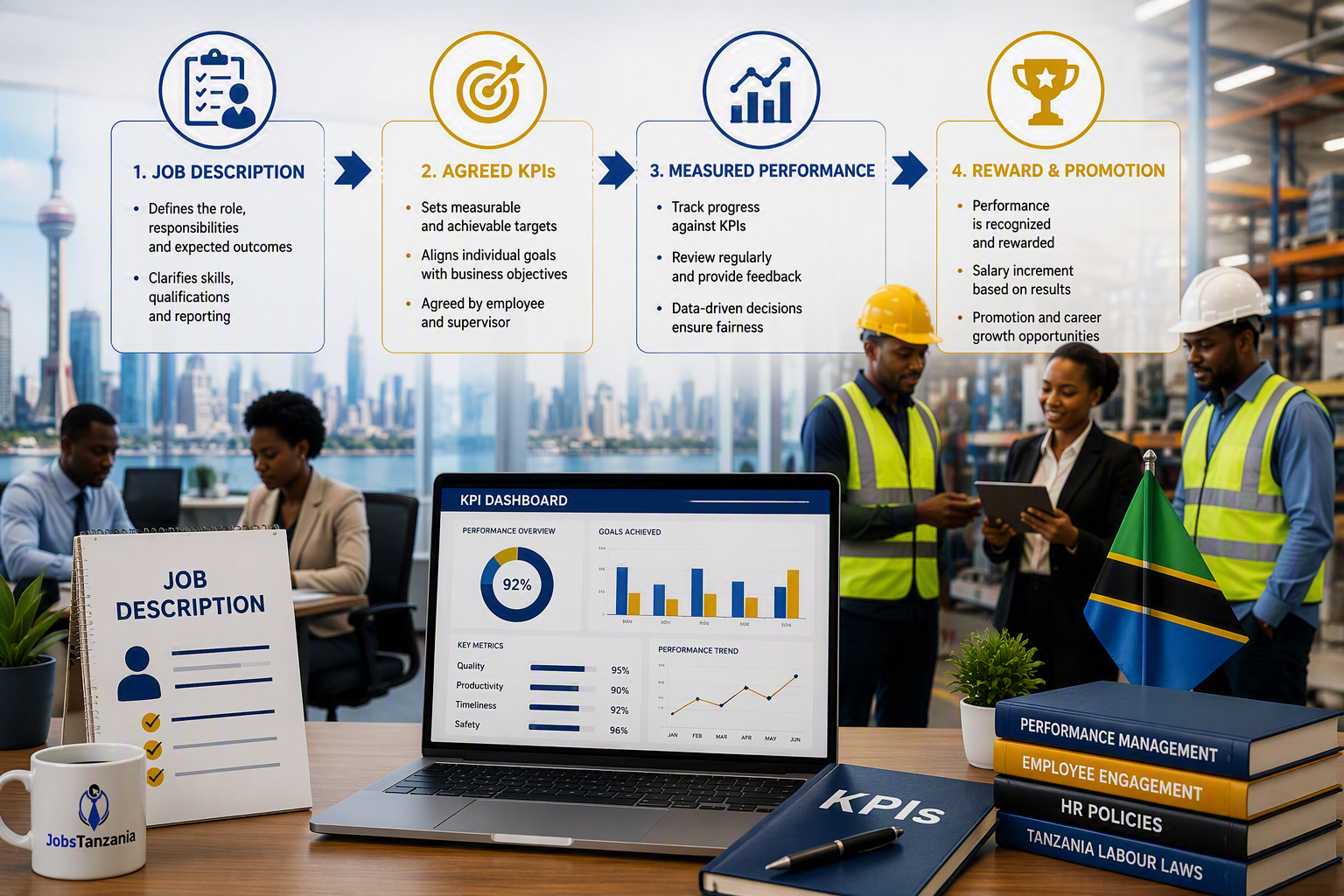
From role definition to measurable performance and fair recognition.
KPIs Require Management Commitment and Resources
KPIs cannot be achieved successfully when management does not provide the necessary support. A sales officer may fail to visit customers because transport is unavailable. The same employee may fail to follow up payments because airtime or approved communication tools have not been provided.
Likewise, a plant manager may struggle to deliver the required production volume if machinery is repeatedly unavailable because critical spare parts have not been approved or supplied. A fair KPI system must therefore document dependencies, available resources, decision rights and risks outside the employee’s control.
Before assessing performance, managers should ask a direct question: did the organisation provide the employee with the authority, tools, information, time and support required to achieve the target?
KPIs Must Be Linked to Fair Recognition
Targets and management support are not enough if performance evidence is never recognised. Employees are more likely to commit to agreed expectations when they understand how performance will be assessed and how strong performance may be recognised under the organisation’s approved policies.
The employee and line manager should agree the KPIs, measurement method, review frequency and evidence source. The agreement should be documented. Regular reviews should identify progress, constraints and corrective action before the final appraisal.
Recognition may take different forms, including feedback, development opportunities, expanded responsibility, bonuses, salary review consideration or promotion consideration. The applicable outcome must follow the organisation’s policy, affordability, internal equity and approval process.
Managers Who Do Not Use KPIs Often Talk Too Much
In organisations without reliable performance measures, managers may spend excessive time repeating instructions and debating whether work has been completed. Well-designed KPIs allow the results to speak through evidence.
Successful performance management is not silent management. Employees still need coaching, context and feedback. The difference is that conversations become more focused. Instead of saying “you are not doing enough”, the manager can show the agreed target, the actual result, the gap, the reason and the required action.
KPIs Can Strengthen Retention and Employer Reputation
Employees are more likely to stay where expectations are clear, managers review performance fairly and strong contribution is recognised consistently. A credible performance culture can also influence whether former employees would consider returning or recommending the organisation to others.
This does not mean KPIs alone will retain every employee. Pay competitiveness, leadership, working conditions, growth opportunities and trust also matter. But KPIs provide an important foundation for fairness and accountability.
An Organisation Without KPIs Can Decline Silently
A business may remain profitable for a period while operating without clear KPIs. However, unclear accountability can hide weak productivity, inconsistent service, avoidable cost and poor decision-making.
Business owners should not wait for performance problems to become visible in customer complaints, declining output or employee exits. A practical KPI framework helps management identify what is working, where performance is slipping and what intervention is required.
KPIs Can Support Business Growth
Organisations that define priorities, measure performance and act on evidence improve their ability to scale with discipline. KPIs do not automatically double a business, and no responsible adviser should promise that outcome. What KPIs can do is make priorities visible, support faster corrective action and align individual contribution with organisational goals.
It is better to swim in an ocean whose depth is known than in one whose depth is unknown. In the same way, it is safer to manage a business with visible measures than to rely on assumptions.
Tanzania Context: Fair Performance Standards Matter
In Tanzania, performance management should be implemented with clear standards, documented communication and fair process. The Employment and Labour Relations Act provides the national framework for core labour rights, employment standards, collective bargaining and dispute prevention and settlement. Employers should obtain qualified advice when performance management may lead to disciplinary or termination decisions.
A Practical KPI Implementation Checklist for Employers
· Review each current job description and confirm the role purpose, reporting line, responsibilities and decision rights.
· Convert the most important responsibilities into a balanced set of measurable results.
· Define the target, measurement method, evidence source, review frequency and owner for each KPI.
· Confirm that the employee has the tools, authority, information and resources needed to deliver.
· Agree the KPIs with the employee and document any assumptions or dependencies.
· Hold regular performance discussions rather than waiting for the year-end appraisal.
· Document support provided, performance gaps, corrective actions and agreed follow-up dates.
· Apply salary, bonus and promotion policies consistently, with appropriate review and approval.
· Check that performance standards remain relevant when the role, system, market or operating conditions change.
· Use qualified HR or legal support where performance action may create compliance or employee-relations risk.
|
Need Help Turning Job Descriptions into Practical KPIs? JobsTanzania HR Services supports employers with job-description reviews, KPI design, performance frameworks, HR policies, employee engagement, and practical HR operational support. Contact: HR@JobsTanzania.co.tz | +255 752 296 850 |
Conclusion: Define the Role, Measure the Result, Recognise the Value
A job description establishes the role. KPIs clarify what successful performance looks like. Resources make delivery possible. Regular reviews create accountability. Fair recognition connects contribution to growth.
For employers, the message is simple: do not manage performance through instructions and assumptions alone. Build a system that employees can understand and managers can apply consistently.
For employees, ask for clarity. Understand the role, agree the measures, keep evidence of results and use review discussions to address barriers early.
Next in the series: How to Set Practical KPIs for Employees: A Step-by-Step Guide for Tanzanian Employers.
Continue Reading on JobsTanzania
- JobsTanzania Career Intelligence Blog
- How to Write a Winning CV in Tanzania (2026 Guide)
- How to Write a Job Description that Attracts Better Applicants
- Post a Job on JobsTanzania
Frequently Asked Questions
What is the difference between a job description and a KPI?
A job description defines the role and its responsibilities. A KPI measures an agreed result, standard or outcome linked to those responsibilities.
Do KPIs automatically guarantee a salary increase?
No. KPIs provide performance evidence, but salary decisions also depend on company policy, affordability, market position, internal equity and approval.
Can operational and lower-level roles have KPIs?
Yes. Measures can cover output, quality, time, safety, attendance, accuracy, cost or service, provided they are relevant, fair and within reasonable control.
How often should KPIs be reviewed?
The review cycle should be agreed in advance. Managers should discuss progress regularly enough to act on constraints before the final appraisal.
Can JobsTanzania help an employer develop KPIs?
Yes. JobsTanzania HR Services can support job-description review, KPI design and practical performance-management frameworks based on an agreed scope.
About the Author
Emily Sebashahu is HR Services Consultancy Manager at JobsTanzania. Emily supports employers with recruitment, HR operations, performance management, employee relations, training and practical workforce solutions. This article launches a practical series designed to help employers build clearer roles, stronger performance systems and more consistent people decisions. You can connect with Emily by sending him a request on LinkedIn.