


How the new Recruitment Agency account helps you publish, promote and shortlist talent in Tanzania
|
The recruiter advantage Recruitment agencies can now register in a dedicated category, present an agency identity, choose how candidates apply, and use featured visibility to drive the right response. Jobs can also be distributed through the JobsTanzania LinkedIn audience of 158,000 followers. |
Quick answer
|
What changed for recruiters? JobsTanzania now gives recruitment agencies a clearer route that is separate from ordinary employer registration. The agency can build its own presence, publish vacancies for clients, select the right application destination, increase exposure for urgent roles and manage candidate response from one workflow. |
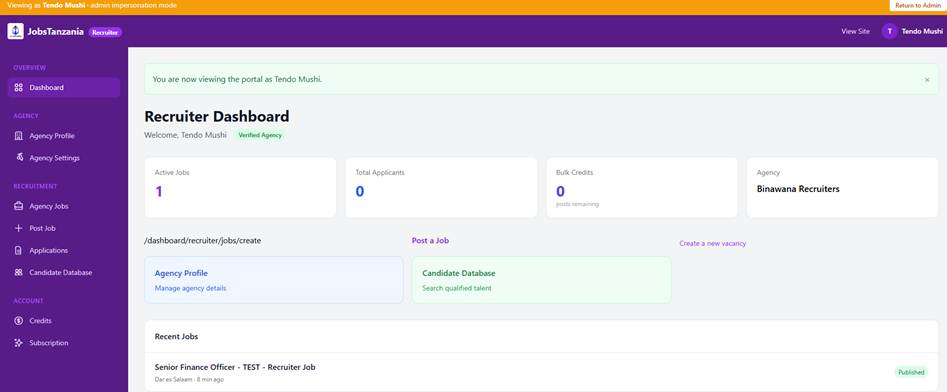
Why recruitment agencies need a separate pathway
An employer normally recruits for its own workforce. A recruitment agency may advertise multiple roles for different clients, protect client confidentiality, manage candidate traffic across several campaigns and prove delivery speed. Treating both users as identical creates unnecessary friction and weakens the agency’s professional identity.
The new Recruitment Agency option solves that positioning problem. It makes the purpose of the account clear from registration and gives recruiters a stronger foundation for repeat hiring, branded listings and candidate pipeline management.
The problem this feature solves
· Mixed identity: agency vacancies can look like direct-employer vacancies when the account type is not clear.
· Fragmented applications: candidates may be split between email, a client site, WhatsApp and different forms without a deliberate application route.
· Low visibility for urgent roles: a normal listing may not generate enough attention when the shortlist deadline is tight.
· Manual repeat work: recruiters repeatedly rebuild company information, application instructions and promotional posts.
· Weak client reporting: it becomes harder to explain where applicants came from and how the vacancy was promoted.
What recruiters can now do?
|
Recruiter capability |
Why it matters |
|
Register as a Recruitment Agency |
Create an account under the correct business category instead of appearing as a direct employer. |
|
Present an agency identity |
Use consistent agency information so candidates recognise who is managing the vacancy. |
|
Publish client vacancies |
Post opportunities across clients while keeping each job description, location, category and application instruction clear. |
|
Choose the application journey |
Use JobsTanzania Apply Now for an on-platform experience or direct candidates to the approved external application destination when the campaign requires it. |
|
Feature priority vacancies |
Give urgent or high-value roles more prominent placement. The supplied People Project example shows a Featured label, job details, views and an Apply Now button. |
|
Extend distribution |
Use JobsTanzania visibility and LinkedIn distribution to place vacancies before a wider professional audience. |
|
Move faster to shortlist |
Bring applications into a more deliberate workflow, review response and focus effort on candidates who match the stated requirements. |
From registration to shortlist: the step-by-step recruiter playbook
Step 1: Register under Recruitment Agency
Open the JobsTanzania registration page and choose the Recruitment Agency option. Use the agency’s official name, business contact details and a monitored email address. This separates your account from direct employers from the beginning.
Step 2: Complete the agency profile
Add a clear logo, concise agency description, recruitment specialisms, service locations and trusted contact information. A complete profile reduces candidate uncertainty and makes repeat vacancy publishing easier.
Step 3: Prepare a conversion-focused vacancy
Lead with the exact job title, location, contract type and application deadline. Explain the role purpose, essential requirements, responsibilities, application documents and selection process. Avoid vague titles and copied descriptions.
Step 4: Select the right application route
Choose on-platform applications when you want candidates to use a direct Apply Now journey. Choose an approved external destination when the client has an applicant-tracking page or campaign website. Use one primary route to reduce duplicate and incomplete applications.
Step 5: Activate featured visibility for priority roles
Feature roles that are urgent, difficult to fill, high volume or strategically important to the client. Prominent placement helps the vacancy stand out and gives the Apply Now action stronger visibility.
Step 6: Use LinkedIn distribution deliberately
Prepare a short promotional caption with the job title, location, strongest candidate requirement, deadline, and direct application link. JobsTanzania distribution gives the campaign access to a LinkedIn audience of 158,000 followers.
SUBSCRIBE TO JOBSTANZANIA ON LINKEDIN →
Step 7: Review response and build the shortlist
Prioritise stated essential criteria. Track source, completed applications, relevant applicants, shortlist rate and time to shortlist. Report these measures to the client instead of reporting views alone.
Step 8: Reuse what works
Save the strongest job-description structure, screening questions, campaign wording and reporting format. A reusable playbook lowers effort on the next assignment and improves delivery consistency.
Real platform example: People Project featured posting
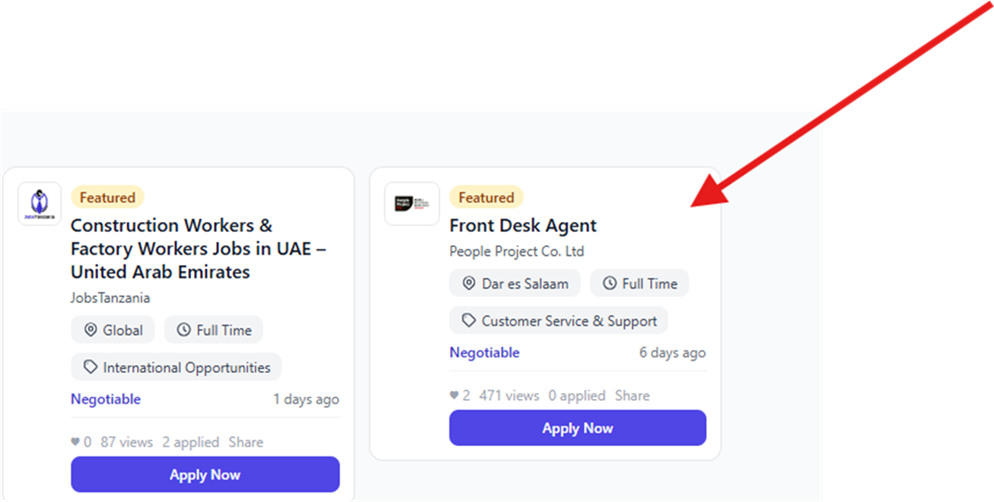
Figure 1. The supplied JobsTanzania screen shows People Project Co. Ltd’s Front Desk Agent vacancy marked Featured, with visible role details and an Apply Now button.
This is what conversion-focused visibility should achieve: the agency name is visible, the vacancy title is easy to scan, key job attributes are displayed, and the candidate has a clear next action. Featured placement is not a substitute for a strong job description, but it gives a well-prepared vacancy a better opportunity to be noticed.
Direct applications or traffic to your site?
|
Decision |
JobsTanzania Apply Now |
External agency/client site |
|
Best when |
You want fewer steps and one immediate Apply Now journey. |
The client or agency requires candidates to complete an external application workflow. |
|
Main benefit |
Lower candidate friction and a more direct response path. |
Traffic, applications and data remain within the approved external recruitment system. |
|
Main risk |
High volume may include weak-fit applications if requirements are vague. |
Every additional click can reduce completed applications. |
|
Recruiter control |
Make screening criteria explicit and review applications consistently. |
Use the exact vacancy landing page, test it on mobile and remove unnecessary redirects. |
|
Recommended use |
General and fast-moving roles where speed and simplicity matter. |
Specialist, confidential or compliance-controlled recruitment campaigns. |
Why start now
· Protect your agency identity: register under the correct category and make every vacancy clearly attributable.
· Create a repeatable pipeline: standardise posting, promotion, application routing and shortlisting.
· Give urgent roles more visibility: use featured placement where speed or scarcity makes normal exposure insufficient.
· Strengthen client confidence: report the campaign pathway and candidate response with evidence.
· Reach candidates where they already engage: combine the job-board listing with JobsTanzania LinkedIn distribution.
|
Your next vacancy can start working harder today Create the dedicated Recruitment Agency account, complete the agency profile and publish one live vacancy. Select the application journey that matches the assignment, then use featured visibility for the role that matters most. |
A practical vacancy publishing checklist
· ☐ Agency account selected during registration
· ☐ Agency name, logo and contact details completed
· ☐ Exact job title and work location stated
· ☐ Employment type and deadline included
· ☐ Essential and preferred requirements separated
· ☐ Responsibilities written in clear, scannable bullets
· ☐ Salary or compensation guidance included where approved
· ☐ One primary application route selected
· ☐ Application link tested on mobile
· ☐ Featured visibility considered for priority roles
· ☐ LinkedIn caption prepared
· ☐ Screening criteria and shortlist owner agreed
· ☐ Campaign measures defined before publication
Measure what converts, not only what is visible
|
Measure |
Question it answers |
|
Listing views |
Did the vacancy attract attention? |
|
Apply clicks |
Did the listing create intent? |
|
Completed applications |
Did candidates finish the chosen journey? |
|
Relevant-applicant rate |
How many applications met the essential criteria? |
|
Shortlist rate |
How efficiently did the campaign produce viable candidates? |
|
Time to shortlist |
How quickly could the agency present qualified candidates? |
|
Source of shortlisted candidates |
Which distribution channel produced genuine hiring value? |
Frequently asked questions
Is the recruiter account different from an employer account?
Yes. The Recruitment Agency pathway identifies the user as a recruiter managing vacancies and candidate pipelines, rather than a company recruiting only for its own workforce.
Can an agency send candidates to its own website?
Use the external application route when an approved agency or client landing page is required. The destination should link directly to the specific vacancy and work correctly on mobile.
When should a vacancy be featured?
Feature vacancies that are urgent, difficult to fill, high volume or particularly important to a client. First ensure the title, requirements and application instructions are strong.
Does visibility guarantee qualified applications?
No. Visibility increases the opportunity to be seen. Relevance depends on the job description, targeting, requirements, application journey and market conditions.
What should the agency report to clients?
Report visibility, application response, relevant-applicant rate, shortlist output, source and time to shortlist. Do not rely on views alone.
How should recruiters use the LinkedIn audience?
Use a concise campaign post linked to the live vacancy. State the role, location, strongest qualification requirement, deadline and exact application action.
Conclusion
|
Final conversion block Recruiters should not have to look like ordinary employers. Build the correct agency presence, publish the next client vacancy and use the visibility tools that match the assignment. |
|
|