

Quick Answer
A AI product manager career in United States can offer strong professional value, but candidates should compare the job title with the actual duties. The cited official evidence reports No official salary exists for this exact title as the relevant pay figure or proxy and No official projection exists for this exact title as the growth figure or limitation. The title is less important than the ability to define a valuable problem, govern data and measure adoption. The practical priority is to build demonstrable evidence, verify local requirements and apply against clearly matched vacancies.
Key Facts
· Official evidence source: BLS Occupational Outlook Handbook.
· Pay evidence: No official salary exists for this exact title.
· Outlook evidence: No official projection exists for this exact title.
· Use product, computer systems and research occupation evidence according to actual duties
· Job titles can be broader or narrower than official occupational classifications.
· Salary varies by location, industry, experience and responsibility.
Why this AI product manager career matters
AI product work sits between ambition and accountability. The manager must decide where automation creates value, what evidence is sufficient and where human judgement remains essential.
The title is less important than the ability to define a valuable problem, govern data and measure adoption. For candidates, this changes the preparation strategy. A generic certificate list is weaker than a short body of proof that connects technical or professional work to a customer, operational, financial or risk outcome.
What the role involves
|
Capability |
What good evidence looks like |
|
Diagnose |
Define the problem, constraints, stakeholders and decision required. |
|
Design |
Compare options and make assumptions explicit. |
|
Deliver |
Turn analysis into a usable process, product, control or recommendation. |
|
Govern |
Protect data, document decisions and manage risk. |
|
Improve |
Measure outcomes, learn from exceptions and refine the approach. |
Source note: capability interpretation by JobsTanzania; official occupational facts are linked separately below.
What the official evidence means
The most defensible benchmark for this article is the BLS Occupational Outlook Handbook. The source reports or supports the following: pay No official salary exists for this exact title; outlook No official projection exists for this exact title. Open the official career source.
Treat these figures as national occupational evidence, not a personal salary forecast. A narrower title may not have its own official series. Compare duties, seniority and geography before using any benchmark in a career or compensation decision.
Skills employers can verify
Problem framing: State the decision, constraints and success measure before choosing a tool.
Technical or domain depth: Show work that is appropriate to the role rather than a broad list of buzzwords.
Communication: Explain a complex issue in plain language and present a recommendation with trade-offs.
Control and ethics: Document assumptions, protect information and identify when escalation is required.
Delivery discipline: Plan work, test quality, record changes and close the loop with users or stakeholders.
Entry routes and qualifications
Entry routes differ by employer and jurisdiction. Use the official profile as the baseline, then verify each vacancy. A degree may be common for some roles, but projects, apprenticeships, professional examinations, technical support experience or adjacent business experience can also matter when the employer explicitly accepts them.
Before paying for training, compare at least ten relevant vacancies. Record repeated requirements, separate mandatory criteria from preferences, and choose learning that closes a verified gap. Training should produce evidence you can demonstrate, not only a badge.
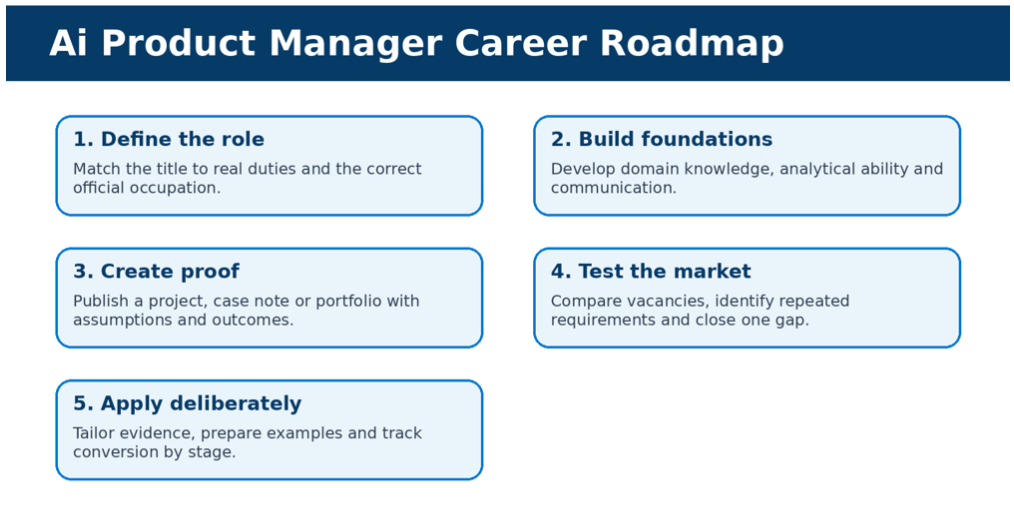
Infographic alt text: Five-step AI product manager career roadmap from role definition to deliberate applications.
A practical 30-day action plan
Days 1-5 - Collect ten vacancies; map titles, duties, required evidence and location.
Days 6-10 - Choose one capability gap and one credible learning source.
Days 11-18 - Build a small project or case note with assumptions, method, outcome and limitations.
Days 19-23 - Rewrite CV and profile around relevant proof, not generic duties.
Days 24-27 - Prepare five interview stories covering judgement, collaboration, quality, risk and improvement.
Days 28-30 - Apply to matched roles; track response, stage reached and feedback.
Common mistakes
· Using a fashionable title without understanding the underlying occupation.
· Quoting a national median as a guaranteed starting salary.
· Listing tools without showing a decision, outcome or quality control.
· Building one generic CV for every vacancy.
· Ignoring location-specific licensing, clearance or employment requirements.
· Publishing portfolio material that exposes confidential or personal information.
Practical checklist
☐ I matched the job title to real duties.
☐ I opened the official source and checked the period and geography.
☐ I can show one relevant project or decision example.
☐ My CV uses truthful, role-specific evidence.
☐ I verified local requirements in the vacancy.
☐ I removed confidential and personal data from public work samples.
☐ I track applications and improve based on conversion evidence.
Frequently Asked Questions
Is this career well paid?
The official benchmark used here is No official salary exists for this exact title. It is not a guaranteed offer. Pay varies by location, sector, experience, scope and employer.
Do I need a degree?
Requirements differ. Review the official profile and the exact vacancy. Some employers accept alternative routes when candidates provide relevant evidence.
Which certification is best?
There is no universal answer. Choose a credential only after identifying repeated requirements in target vacancies and confirming that the credential develops usable capability.
Can I enter from another career?
Yes, where adjacent experience matches the role. Translate existing evidence into the new context and close only the gaps that target employers consistently require.
How should I use AI in an application?
Use AI to organise or edit, not to invent facts. Verify every claim, remove confidential data and ensure the final application reflects your own experience.
What should my portfolio contain?
A short problem statement, method, assumptions, result, limitations and what you would improve. Protect confidential and personal information.
JobsTanzania next step
Explore current opportunities and practical career guides on JobsTanzania. Continue with the JobsTanzania Career Intelligence Blog.
Sources and further reading
BLS Occupational Outlook Handbook: AI Product Manager Career in the United States: Build Credibility Without Inflating the Title
U.S. Bureau of Labor Statistics: Computer and Information Technology Occupations