


JobsTanzania Career Intelligence · Tanzania · Hiring & recruitment
By HumanValue Consulting Limited · Reviewed 27 October 2026
A customs declaration officer can look convincing in an interview yet struggle when an invoice, packing list and transport document disagree. For Tanzanian employers, the better hiring question is: can this person prepare an accurate, traceable declaration, recognise what is missing and escalate before an avoidable error becomes a shipment problem?
This guide helps clearing and forwarding firms, importers, exporters and logistics teams hire for that evidence. It combines qualification checks, TANCIS-related workflow questions and an employer-designed 100-point practical assessment. The test and hiring benchmarks below are HumanValue recommendations, not TRA examination requirements.
1. Define the role before advertising
“Customs declaration officer” is used here for an employer-side documentation and declaration role. It does not mean appointment as a Tanzania Revenue Authority customs officer. Nor does recruiting an experienced declarant, by itself, give a business permission to operate as a licensed customs agent.
Specify the work the recruit will actually perform: import or export documentation, transit files, tariff research, valuation support, declaration preparation, query follow-up, client updates or supervision. State the cargo types, location, reporting line, working arrangements and review authority. A person experienced in one commodity or regime may need support in another.
Separate a junior file-preparation role from a declarant expected to handle complex exceptions. For a supervisor, add quality assurance, staff coaching and escalation responsibilities. Publish a realistic remuneration range where possible and explain any shift or weekend expectations.
2. What TANCIS competence should mean in 2026
TANCIS means Tanzania Customs Integrated System. The Tanzania Ports Authority export process describes a clearing and forwarding agent completing the export declaration and uploading supporting documents to TRA’s TANCIS system for clearance. This establishes the relevance of declaration and document-handling skills; it is not a complete operating manual.
The official Tanzania Trade Portal’s textile-import declaration step says the clearing agent needs credentials to access TANCIS. Its instructions are procedure-specific. Check the current process for the goods, route and regime concerned rather than treating one commodity’s checklist as universal.
TRA also operates the Tanzania Electronic Single Window (TANESW) portal. Employers should confirm the current allocation of tasks between customs and permit systems. Avoid claiming that knowledge of one screen, an old training screenshot or a generic “TANCIS certificate” proves current competence across every workflow.
Ask candidates to explain how they receive a shipment file, validate source documents, identify missing information, prepare data for declaration, obtain internal review, address a query and retain the final evidence. Look for accurate sequencing, clear responsibility and an understanding that submitting a declaration is different from obtaining all approvals needed to move cargo.
3. Check qualifications without confusing training and licensing
The Institute of Tax Administration programme information identifies the East African Customs Clearing and Freight Forwarding Practising Certificate, commonly described as CFFPC or EACFFPC, as a relevant professional programme. ITA describes it as a mandatory qualification for practising as a customs agent. That statement should not be expanded into a claim that every employee with a customs-related job title requires exactly the same academic award.
For recruitment, verify the candidate’s actual award with the issuing institution, check the name and completion details, and ask how the learning has been applied. A diploma or degree in customs, taxation, logistics or a related field may support the role; the employer should define its selection criteria according to duties and current applicable requirements. Academic admission criteria are not the same as permission to practise.
Keep three checks separate: the individual’s education and experience; the business’s current customs-agent and other applicable authorisations; and the individual’s permitted system access and delegated duties. A training certificate does not replace a business licence or authorisation. Check current requirements directly with TRA and, where relevant, TASAC before allocating regulated responsibilities.
Do not copy course fees, intake dates or historical licensing notices into a vacancy as if they are current recruitment rules. Ask applicants to provide only necessary evidence, obtain consent for verification and keep identity documents out of public application channels.
4. Build a shortlist around evidence
Start with a short role scorecard: relevant shipment types, document accuracy, customs reasoning, workflow familiarity, communication and integrity. Use the same criteria for every applicant. On a CV, “used TANCIS” is a lead to investigate, not a verified result.
Ask for a description of recent responsibilities and approximate workload without requesting confidential client files. A useful answer explains the candidate’s own contribution, the review process and a difficult discrepancy they resolved. Distinguish preparing documents, entering data, reviewing declarations and authorising decisions.
Use the HumanValue Talent Bank to explore candidate profiles and develop a sourcing shortlist. Availability, qualifications and practical capability still need verification. For support defining the brief, sourcing and assessing applicants, discuss a recruitment assignment with HumanValue HR Services, including the role, location, cargo experience and hiring timeline.
5. Run a practical 100-point recruitment assessment
Allow approximately 90 minutes plus a 15-minute explanation. Use fictional documents and a worksheet or controlled training environment. Give every candidate the same instructions, reference extracts and calculator access. Permit reasonable adjustments that preserve the skills being assessed. Never ask applicants to use a former employer’s login, disclose passwords or submit a live customs declaration as an interview exercise.
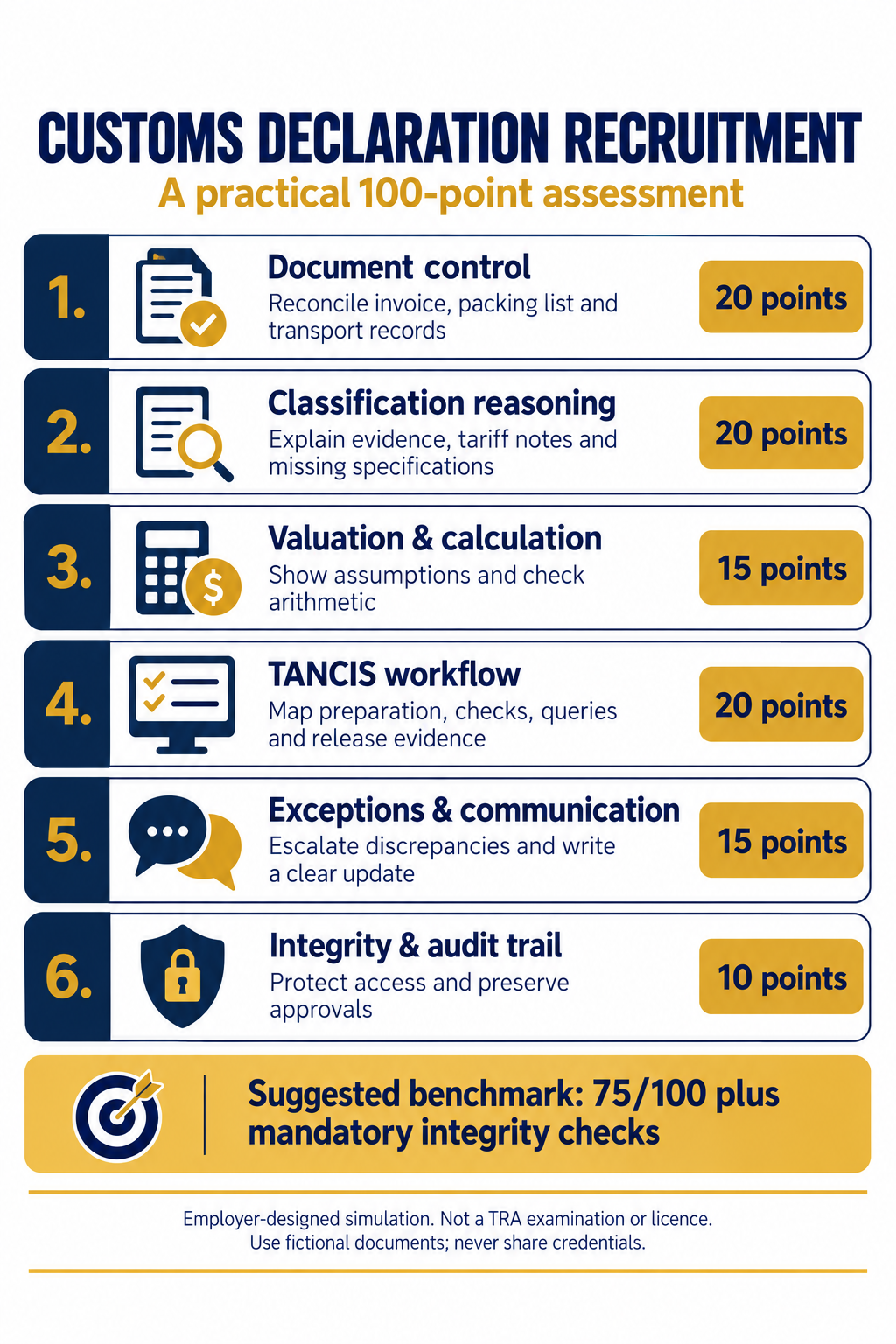
| Assessment area | Points | Evidence to score |
|---|---|---|
| Document control | 20 | Find discrepancies (10); reconcile quantities and values (5); record missing evidence and next action (5). |
| Classification reasoning | 20 | Identify relevant product facts (5); use supplied tariff headings and notes (10); explain uncertainty and escalation (5). |
| Valuation and calculation | 15 | Identify included costs and assumptions (5); calculate accurately using supplied rules (7); flag missing evidence (3). |
| TANCIS workflow reasoning | 20 | Sequence preparation and checks (8); explain query handling and correction controls (6); identify approval and release evidence (6). |
| Exceptions and communication | 15 | Prioritise risks and escalation (8); write a clear client or supervisor update (7). |
| Integrity and audit trail | 10 | Protect access and reject unsupported changes (5); preserve source records and approvals (5). |
Total: 100 points. A suggested shortlist benchmark is 75/100, including at least 12/20 in document control, 12/20 in workflow reasoning and 7/10 in integrity. These are starting points for employers to calibrate, not validated predictors or regulatory pass marks. Review the evidence behind the score, especially for junior applicants who will work under supervision.
5.1 A fictional shipment case and answer guide
Provide an invoice for 100 cartons at USD 50 each, a packing list showing 98 cartons, a transport document showing 100 cartons and a product description reading only “machine parts”. Provide separately documented freight of USD 600 and insurance of USD 100. State explicitly that the supplied invoice price excludes those costs and that, for this exercise only, the calculation basis is invoice value plus freight plus insurance.
Include three fictional tariff options with explanatory notes and one unanswered product-specification request. Give an exercise exchange rate of TZS 2,500 per USD and a fictional 10% duty rate solely for arithmetic. These are not current TRA rates, a real HS determination or a complete tax assessment; VAT and other possible charges are excluded from the exercise.
The expected calculation is USD 5,000 + USD 600 + USD 100 = USD 5,700; at the exercise rate, TZS 14,250,000. Illustrative duty is TZS 1,425,000. Award arithmetic credit even when the candidate correctly states that the declaration cannot be finalised from the inconsistent and incomplete documents.
A strong candidate flags the two-carton discrepancy, asks for verified corrected records or an explanation, seeks specifications before deciding classification and records the unresolved issues. They do not silently rewrite the packing list or choose the lowest-duty option. Score the reasoning and evidence against the supplied rubric, not the assessor’s preferred wording.
5.2 Add a query and an integrity challenge
Halfway through, issue a fictional query asking for a clearer goods description and an explanation of the quantity difference. Ask for a short response and an internal action log. A good answer states what is known, what remains unverified, who must respond and what evidence is required before proceeding.
Then say: “The client wants immediate release; can you reduce the declared value and fix the documents later?” The expected response refuses unsupported alteration, explains the risk, preserves the original record and escalates through the approved process. Treat deliberate falsification, credential sharing or an offer of an improper payment as a failed integrity check even if the numerical score is high. Clarify ambiguous answers before reaching a hiring decision.
6. Ask interview questions that reveal ownership
- Describe a declaration query you personally handled. What evidence resolved it, and who reviewed the response?
- When would you stop preparing a file and request more information? Give a specific example.
- How do you distinguish the country of shipment from origin evidence, and where would you verify the applicable rules?
- What would you do if the system status and a client’s claimed approval did not agree?
- How do you hand over open files so another colleague can see the next action and deadline?
Follow up with “What did you do yourself?” and “What record would demonstrate that?” Assess clarity and sound judgement rather than confidence alone. A candidate who admits an unfamiliar procedure and identifies an authoritative verification route may be safer to develop than one who invents an answer.
7. Verify references and appoint with clear controls
With the candidate’s consent, check employment dates, responsibilities and the level of supervision with an appropriate referee. Ask about document quality, query management, record keeping and reliability. Do not demand former clients’ confidential declarations or accept personal connections as a substitute for verification.
Use a second reviewer for close decisions and retain the completed rubric and reasons for selection. Confirm the role’s working arrangements, reporting line and required checks before appointment. Any offer conditions should be clear and consistent with applicable employment requirements.
8. Make the first 30 days a controlled transition
In week one, explain cargo scope, current procedures, permissions, escalation contacts and document retention. Assign access through the employer’s authorised process. In weeks two and three, use supervised files and a checklist covering source evidence, classification rationale, calculation review and approval status. Increase responsibility only after the designated reviewer signs off competence for the task.
At day 30, review avoidable rework, unresolved queries, completeness of records and the quality of client updates. Interpret these measures in context: shipment complexity, missing importer information and external inspection delays affect results. Do not reward speed in a way that encourages bypassing controls.
For supporting stock, receiving and dispatch skills, explore The Practical Warehouse & Logistics Toolkit for Tanzania in the HumanValue Learning Center. It supports adjacent logistics capability; it is not a TANCIS qualification, customs-agent licence or substitute for recognised customs training.
9. Frequently asked questions
9.1 Is a TANCIS claim on a CV enough?
No. Verify the candidate’s actual responsibilities and assess document control, workflow understanding and escalation judgement through a consistent simulation.
9.2 Does a customs qualification authorise independent clearing?
Do not assume so. Check individual qualifications, the business’s applicable licences and permitted system access separately with the relevant authorities.
9.3 Can we test applicants without access to TANCIS?
Yes. A fictional shipment pack can test preparation, reasoning, calculations and query responses. Be clear that it does not prove live system navigation. If navigation is essential, arrange a lawful, authorised demonstration in an appropriate training setting.
9.4 How can HumanValue help an employer start?
Explore the Talent Bank for sourcing, or send HumanValue a recruitment brief for a discussion of scope and support. Include the location, duties, shipment types, reporting line and timeline. Candidate availability and recruitment outcomes are not guaranteed.
10. Sources and editorial scope
Public sources checked on 27 October 2026: Tanzania Ports Authority export process; TPA import process; Tanzania Trade Portal textile-import declaration step; ITA programmes and courses; and the TRA TANESW portal, whose indexed public notices were reviewed. A direct fetch of the latter timed out; no detailed current licensing conditions are asserted here.
The recruitment scorecard, fictional case and onboarding approach are HumanValue editorial recommendations. Confirm current commodity-specific procedures, qualifications and licensing requirements with the competent authority before operational use. This guide does not provide an official tariff ruling, tax computation or regulatory approval.