


HumanValue Employer Intelligence | Tanzania | Researched 8 November 2026
A review of unresolved customer requests should end with decisions, accountable owners and realistic next updates. Reading out a list of old cases is not enough. The manager needs to know what is blocking progress, what the customer currently understands and which decision will move each priority case forward.
For Tanzanian service businesses, requests may arrive through calls, email, a counter or approved messaging channels. The challenge is to keep a coherent record without forcing every customer to repeat the story. This guide proposes a practical management review, with a fictional example and clear boundaries around promises, staff responsibilities and process improvement.
Define unresolved work before comparing totals
A request can be waiting for the customer, an internal decision, a supplier or an employee’s next action. Those situations require different responses. If they all appear as “pending”, a manager cannot tell whether to ask for information, approve an exception or rebalance work.
Use statuses that match your actual workflow and define what each means. Separate the case owner from the person currently holding the next action. A request can remain owned by the service team while a specialist answers a technical question.
For comparison, Zendesk’s status guidance distinguishes work awaiting a requester from work waiting on another party. Those are product-specific definitions, not a required vocabulary for every Tanzanian business. The useful principle is to make the dependency visible.
Bring a decision-ready case list
Before the review, ask owners to update the current facts, last meaningful customer contact, next action and decision needed. A copied message chain is not a substitute for a clear summary. Keep the underlying evidence accessible to authorised staff, while using only necessary details in the meeting.
| Field | What it should show | Question for the manager |
|---|---|---|
| Impact and urgency | What the customer cannot do and any relevant time constraint | Does this require immediate attention under our rules? |
| Current dependency | The information, action or approval preventing progress | Who can resolve this dependency? |
| Case age | Time since creation, using an agreed definition | Why is the case still open? |
| Last meaningful update | What was communicated and when | Is the customer waiting without a clear next contact? |
| Next action and owner | A specific task and accountable person | What will happen after this review? |
| Decision and authority | The approval needed and its responsible role | Can we decide now or must we refer it? |
Do not treat every old request as more urgent than every new one. Age is a signal, while impact, risk and contractual or operational requirements also matter. Apply the organisation’s escalation rules to safety, suspected fraud or other serious concerns rather than waiting for a routine meeting.
A fictional review: twelve open requests, three different problems
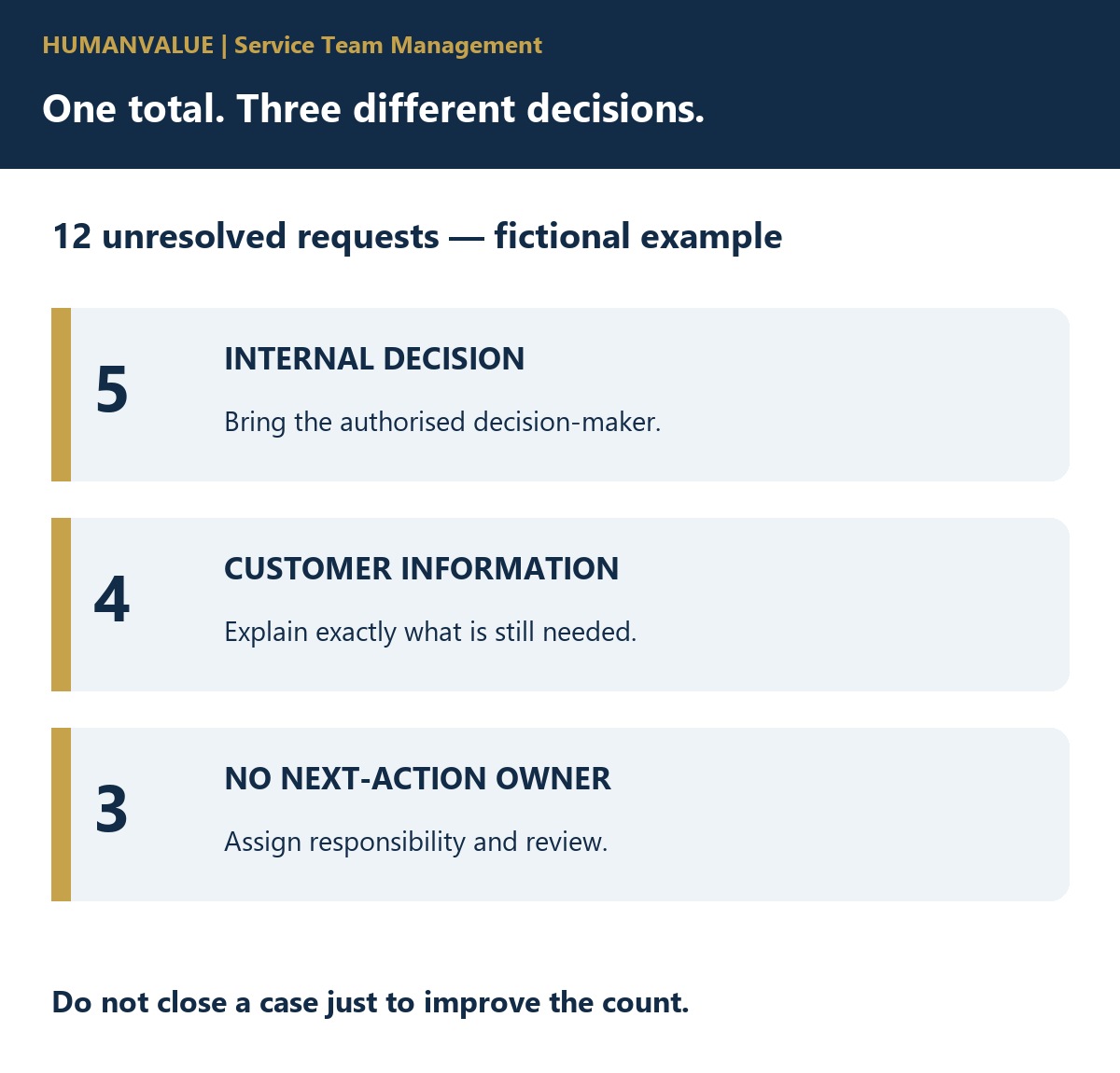
Imagine a fictional service team with twelve unresolved requests. Five are waiting for an internal decision, four require customer information and three have no named next-action owner. These invented numbers illustrate classification; they are not a HumanValue client result or an industry benchmark.
The five internal-decision cases need the appropriate decision-makers, not another round of generic reminders to service agents. The four awaiting customer information need a clear, proportionate request explaining what is missing and why. The three unassigned cases need ownership and a first review before anyone can make a sensible commitment.
The manager should inspect individual cases rather than assume every item in a group has the same answer. One internal decision may be routine; another may require specialist advice. One customer may not have received the request for information. Another may have replied through a different approved channel.
Fictional decision note: “Case S-108 remains open because approval for the proposed remedy is outstanding. The service lead will submit the required evidence to the authorised manager. The case owner will update the customer at the agreed contact time, even if the approval is still pending. No remedy has yet been promised.”
Measure the work without rewarding premature closure
A falling open-case count can look encouraging while hiding unresolved needs. Check what the count includes, how duplicates are handled and what happens when a customer reopens a case. A closed status should follow the actual closure rules rather than a desire to improve the report.
Zendesk’s support-metrics guidance discusses reviewing backlog alongside age and response measures. Apply the broader idea carefully: a count tells you how much work is recorded; it does not tell you whether the customer received a useful answer.
Use a small set of measures your team can explain. Review volume, ageing bands, missed agreed updates and recurring dependencies. Define the period and denominator for any percentage. Separate a snapshot of open work from requests received or resolved during a period; they describe different things.
Make customer updates specific and realistic
An update should state what is known, what remains unresolved and when the customer will next hear from the team. Avoid repeating “we are working on it” without useful context. Where a date depends on another party, say what can be committed to: a follow-up or next contact, rather than an unapproved resolution deadline.
Check the preferred and authorised communication channel. Do not ask customers to send sensitive documents through an unapproved route. Do not disclose internal employee disagreements or unrelated case details to explain a delay. The customer needs a clear account of their request and the next step.
Use recurring problems to improve the process
If the same approval repeatedly blocks cases, review the evidence required, decision route and available authority. If requests are repeatedly misrouted, inspect intake questions and handover rules. A training session may help, but a broken approval structure is not solved by telling agents to communicate better.
Assign improvement actions separately from individual case actions. A manager can approve a revised handover process while the team still needs to resolve each affected customer request. Record the change, its owner and how the team will assess whether it helped. Do not claim a reduction in complaints without reliable before-and-after evidence.
Questions service managers ask
Should the whole team attend every review?
Invite the people needed to make or prepare decisions. Share appropriate summaries with others. A smaller meeting with clear authority can be more useful than a long meeting in which no one can decide.
Can a case be closed because the customer has not replied?
Follow the actual service policy, agreed terms and any applicable requirements. Check whether the customer received a clear request and whether the defined follow-up process was completed. Do not invent a universal waiting period.
Does every delay mean the employee is underperforming?
No. Examine workload, information, authority and system dependencies as well as individual actions. Use evidence before deciding what support or management response is appropriate.
Discuss the service-team brief with HumanValue
If you need HumanValue HR or recruitment support, explain the service roles, reporting lines and skills you need to strengthen. Agree whether the engagement concerns role definition, recruitment, assessment or staff-development support, together with responsibilities, timing and fees. Operational approval and customer-remedy decisions remain with your authorised team.
For the employee-level workflow, read our complaint-log and escalation guide. For organising a fictional review register, consider Workplace Excel Essentials in the Learning Center. Choose resources against the actual gap rather than treating software as the whole solution.
Editorial contact: Emily Sebashahu
HR Services & Recruitment Director, HumanValue Consulting Limited.
Follow Emily on LinkedIn for HR and recruitment insights.