

Hiring a maintenance technician should not be decided by a certificate, a confident interview or a list of machines on a CV alone. A better employer process tests how the candidate diagnoses a fault, isolates hazards, documents an intervention and returns equipment to service through an authorised procedure. For Tanzanian manufacturers, food processors, workshops and logistics facilities, these behaviours are more relevant than a vague claim of 'five years of maintenance experience'.
This article provides a practical 100-point assessment, a structured recruitment workflow and a 60-day onboarding model. It is a hiring framework, not an assertion that any particular employer has vacancies, that a trade test can replace legally required qualifications, or that HumanValue has certified the candidates in its database.
Start with the failure mode, not the job title
'Electrical technician', 'mechanical fitter', 'maintenance technician' and 'industrial electrician' may describe overlapping but different duties. Before advertising, the plant manager and HR should list the actual assets, typical breakdowns, maintenance schedule, shift pattern, tools, reporting line and required authorisations. A conveyor motor, refrigeration compressor, generator, boiler and high-voltage installation require different competencies and risk controls.
Divide requirements into three categories. Essential: skills and authorisations without which the person cannot safely perform the job. Trainable: local equipment, software and reporting conventions that can be learned after hiring. Desirable: additional experience that improves flexibility but is not a substitute for the essentials. This distinction widens the pool without weakening safety.
For example, a beverage plant might need technicians who can read wiring diagrams, identify sensor faults, follow isolation procedures, inspect bearings and document preventive maintenance. It should not advertise for an undefined 'engineer' and then reject capable technicians because they lack a degree that is not needed for the actual tasks.
Build a 100-point evidence scorecard
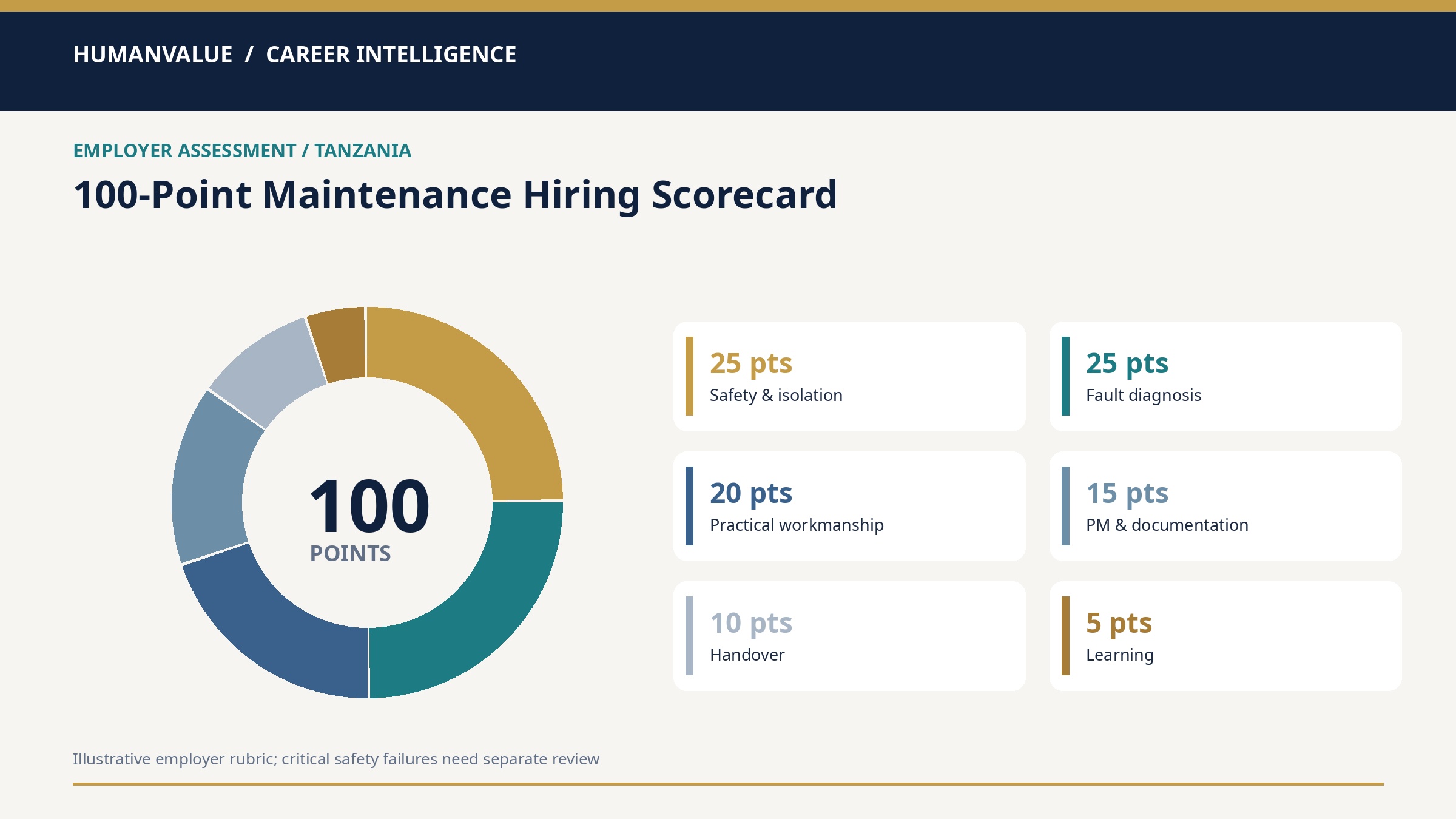
Use the following illustrative employer-designed scoring framework, adapting thresholds to your plant and validating it with competent safety and technical staff. The points are not a national certification or legal requirement.
Safety and isolation: 25 points. Candidate identifies energy sources, explains the site-approved isolation and verification process, recognises stored energy and refuses unsafe shortcuts. A critical safety failure should trigger review or disqualification regardless of total score. Do not ask candidates to perform hazardous live work for recruitment purposes.
Fault diagnosis: 25 points. Candidate interprets a symptom, forms testable hypotheses, selects appropriate checks and separates root cause from a temporary workaround. Score reasoning and evidence, not speed alone.
Practical workmanship: 20 points. In a safe training rig, assess measurement, inspection, basic mechanical or electrical technique appropriate to the role, tool selection and work quality. Use a qualified assessor and safe, de-energised equipment.
Preventive maintenance and documentation: 15 points. Candidate reads a sample PM schedule, records findings, distinguishes urgent from routine defects and produces a traceable work order.
Communication and shift handover: 10 points. Candidate explains the issue to a production supervisor without technical jargon, records what remains unresolved and communicates safe operating restrictions.
Learning and improvement: 5 points. Candidate identifies a repeat-failure pattern and suggests how to verify whether a preventive action worked.
The total is 100 points, but employers should not equate a high total with unrestricted competence. Regulatory permissions, site induction and supervision remain separate controls.
The practical assessment: four short stations
Station A, fault description. Provide a fictional work order: 'Packaging conveyor stops intermittently after twenty minutes; overload trip reported twice.' Ask the candidate to list the first five checks and the hazards they would control before any physical intervention. Do not provide a real energised machine as a surprise test.
Station B, diagram reading. Use an approved training schematic of a simple motor control circuit or a mechanical assembly. Ask the candidate to trace the function and identify what information is missing. A good candidate will say 'I need the equipment manual or isolation confirmation' when appropriate rather than bluffing.
Station C, preventive maintenance. Provide a sample checklist with bearing temperature trend, vibration observation and lubrication interval. Ask what they would record, what would prompt escalation and what would not justify restarting a machine.
Station D, handover. Ask for a five-sentence report: fault, checks performed, findings, status and next action. The report should state who authorised the work and any restriction remaining. This station helps distinguish a technically capable worker who can support a reliable team from one who leaves undocumented risks.
Each station should use the same instructions, time and scoring rubric for comparable candidates. Make reasonable adjustments for disability and language where they do not compromise genuine safety requirements. Avoid questions about personal characteristics unrelated to job performance.
A fictional score comparison that prevents a costly shortcut
Candidate A has eight years of general maintenance experience and gives strong verbal answers but omits energy isolation in the practical scenario. Candidate B has three years of relevant industrial experience, correctly identifies hazards, uses the manual and documents the fault clearly. It would be a mistake to choose Candidate A automatically based on tenure. The employer should first evaluate the safety-critical omission and whether Candidate B meets the essential role requirements.
Neither candidate is an actual HumanValue profile. The example shows why evidence-based selection matters; it does not prove that one candidate will deliver a specific downtime reduction.
The first 60 days should test reliability, not heroics
Days 1–10: safe induction. Verify qualifications and relevant licences where required, issue site procedures, map authorised equipment, explain permits and isolation rules, and assign a competent supervisor. Establish a baseline of open work orders and recurring faults. No new technician should be rewarded for bypassing safety to 'get the line running'.
Days 11–20: supervised execution. Assign low-risk preventive tasks and controlled diagnostics. Review whether work orders include equipment ID, symptom, intervention, parts used, verification and sign-off. Track completion quality rather than number of tickets alone.
Days 21–40: problem-solving and handovers. Have the technician participate in a repeat-fault review, produce a cause-and-evidence note and propose a preventive action for supervisor approval. Observe cooperation with production and stores teams.
Days 41–60: readiness review. Evaluate safe conduct, technical work, documentation, reliability and learning. Decide which assets and tasks the employee may handle independently, which still require supervision and what training remains. Use documented feedback and the employee's opportunity to respond.
Measure what maintenance can influence
Three operational indicators are useful when defined carefully. Planned maintenance completion compares completed approved tasks with tasks due in the period, excluding properly rescheduled work according to a written rule. Repeat fault rate counts verified recurrences of the same failure mode within a defined observation window. Work-order closure quality audits whether required evidence and sign-off are present.
Mean time between failures and mean time to repair can help in mature data environments, but are easy to distort when assets, operating hours and failure definitions are inconsistent. Do not set an arbitrary percentage improvement target and attribute it to a new hire without baseline data. Separate process outcomes from production demand, spare-parts availability and capital equipment condition.
The International Labour Organization's occupational safety and health guidance treats a safe and healthy working environment as a fundamental right at work. In Tanzania, employers should consult the Occupational Safety and Health Authority and relevant site-specific requirements for inspections, training and safe systems. A recruitment scorecard complements, but never replaces, compliance.
Source candidates without treating a CV search as certification
Start with a clear vacancy that identifies the type of plant, essential skills, location, shift pattern, qualifications and selection steps. A role-specific advertisement can be published through JobsTanzania employer plans. The public catalogue reviewed on 25 October 2026 lists a single vacancy at TZS 20,000, an Employer Monthly plan at TZS 79,000 per 30 days, and an annual plan at TZS 690,000. The monthly plan includes Talent Bank access with a stated allowance of ten candidate-profile unlocks per 30 days. Check live terms at checkout.
The HumanValue Talent Bank publicly advertises a seven-day trial with up to three unique candidate unlocks and a separate Talent Search option at TZS 40,000 per 30 days. It can help an employer discover profiles by manufacturing, engineering, experience and location. It does not remove the need to verify credentials, assess skills, check availability and obtain appropriate consent for candidate contact.
If HR capacity is limited, HumanValue recruitment services describe a curated search and human-reviewed shortlist on a quoted assignment. Ask for a written scope: role brief, screening criteria, technical-assessment responsibilities, verification, shortlist delivery and agreed placement terms. Do not invent a fixed placement fee where the catalogue provides a quote-based service.
Make candidate experience part of the process
Tell applicants whether the assessment is written, practical or both; where it will take place; the safety conditions; how long it will last; and whether travel support is offered. Avoid demanding unpaid productive maintenance work as an 'interview'. Provide a contact for reasonable accommodation and explain when decisions are expected. Store assessment notes and CVs in controlled systems consistent with Tanzania's Personal Data Protection Commission guidance.
A credible employer can also publish the essential criteria in advance and provide structured feedback where feasible. This reduces the temptation to rely on personal connections, appearance or unsupported assumptions. Where a trade licence, registration or formal certification is mandatory, make that a separate verified gate rather than scoring it as optional.
FAQs
Is a diploma enough to hire a maintenance technician?
A qualification may be necessary, but it does not by itself demonstrate safe competence on the actual plant. Verify credentials, authorisations and performance in a safe assessment.
Should every candidate do the same electrical test?
No. Assess duties relevant to the vacancy. Mechanical, electrical, instrumentation and refrigeration roles require different tests and competent assessors.
Can we search the Talent Bank before posting a vacancy?
The public Talent Bank offers a search-only option and a trial. Confirm current access terms and permitted candidate-contact rules.
Is the 100-point rubric an official Tanzanian standard?
No. It is an editorial example that employers should adapt with their safety and technical teams.
What should we review after 60 days?
Review safe working, completed authorised tasks, evidence quality, recurring problems, training needs and supervisor feedback. Do not treat the first 60 days as a substitute for lawful employment processes.
Employer action plan
Write a one-page asset-specific role brief, approve the safety-critical criteria and pilot the four-station assessment on a fictional training fault before inviting applicants. Then choose the appropriate JobsTanzania posting or employer subscription, explore Talent Bank search or request a scoped HumanValue recruitment assignment. A strong technician hire is not simply someone who can restart a machine; it is someone who can help the organisation maintain it safely, explain the evidence and prevent avoidable repeat failures.
Editorial scope: general employer guidance. All cases and score thresholds are illustrative. Verify applicable occupational-safety, labour and professional requirements before use.