

Quick answer: test the controls, not only the CV
The best HR and payroll officer is not necessarily the candidate who remembers the most tax rates during an interview. The employer needs someone who can reconcile employee records, protect sensitive information, explain exceptions, maintain a dependable approval trail and know when to escalate a legal or payroll question. A realistic hiring assessment should test those behaviours with fictional data and a consistent scoring rubric.
This guide is for Tanzanian employers hiring payroll officers, HR generalists with payroll duties or HR administrators moving into a payroll function. It offers a 100-point assessment and 60-day onboarding plan, not a salary survey or a claim that any particular candidate is available. Start by defining the role and choose whether to post a vacancy, explore HumanValue Talent Bank or request a quoted recruitment assignment.
Clarify the role before advertising
A payroll officer may own monthly inputs, statutory deductions, reconciliation, payslip production, employee queries and payment preparation. An HR officer may focus on contracts, leave, recruitment records, disciplinary administration and workforce reporting. In a small organisation, one person may support both. The vacancy should distinguish work the hire prepares, reviews, approves and releases.
Do not give one person uncontrolled authority to create employees, change bank details, approve salary changes and release payments. Separation of duties is a management control, not a personal criticism of the candidate. If the team is small, use compensating checks such as independent sign-off, change logs and monthly reconciliations.
List the systems in use, the number of employees, locations, pay cycles and whether payroll is processed internally or by a provider. Do not state a salary band without a defensible budget and current benchmark. Avoid asking candidates for previous payslips or personal financial records unless a legitimate, proportionate need has been established.
Build the 100-point assessment
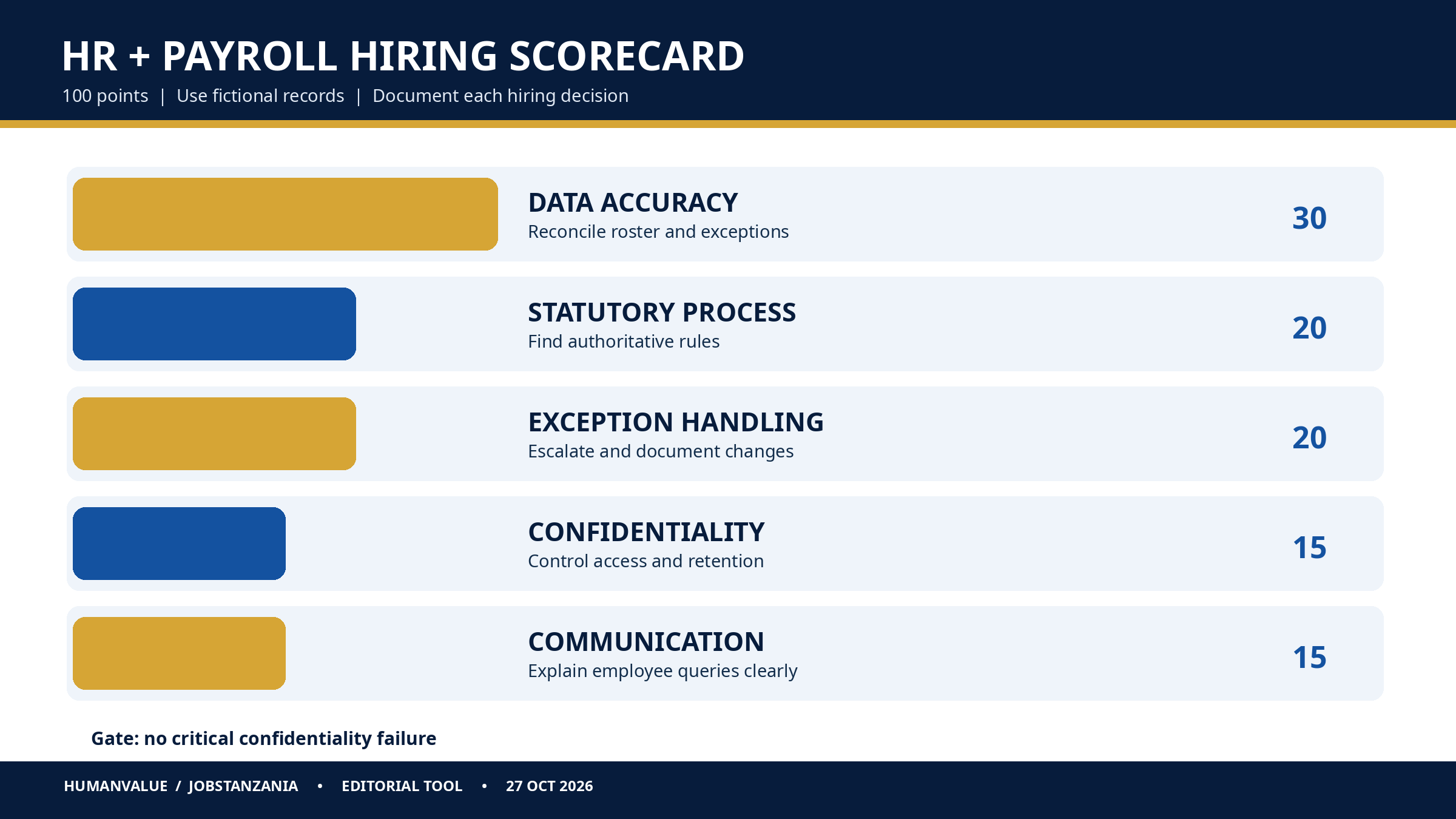
Use five domains with weights: data accuracy 30 points, statutory-process awareness 20, exception handling 20, confidentiality 15 and communication 15. Give every shortlisted candidate the same fictional dataset, time allowance and instructions. Adjust reasonable accommodations where needed and document the adjustment without changing the competence standard.
The data accuracy exercise contains a fabricated roster of eight employees. Include one duplicate ID, one missing approval, one leave adjustment and one changed bank account that has not been independently verified. Ask the candidate to identify exceptions before calculating totals. A strong answer pauses an unverified bank change rather than simply copying it into the payroll file.
The statutory-process exercise asks which sources the candidate would consult, not merely whether they can recite a percentage. Tanzania's NSSF contribution guidance describes a total 20% contribution on the relevant wage basis, with employee share not exceeding 10% under its stated arrangements. Candidates should explain that the applicable scheme, wage basis, current legislation and employer arrangement must be confirmed. Never grade a candidate on an invented tax table.
The exception-handling exercise presents a fictional late overtime approval and a request to backdate an employee's start date. A reliable candidate identifies the missing authorisation, records the exception and proposes a controlled correction. An unsafe answer silently changes records to make the file balance.
For confidentiality, ask the candidate to explain who should receive a payroll report, how access should be controlled and how files should be transferred. Tanzania's Personal Data Protection Act establishes a legal framework for handling personal information. A good answer includes least-privilege access, clear retention responsibilities and secure disposal, while acknowledging that detailed obligations require legal and operational review.
For communication, ask for a three-sentence response to an employee who reports an unexplained deduction. Strong answers acknowledge the concern, state what will be checked, protect the employee's privacy and provide a realistic follow-up time. Avoid rewarding candidates who promise an immediate refund before confirming the records.
A sample scorecard employers can use
Data accuracy: identify duplicate employee, missing approval and reconciliation variance, up to 30. Statutory process: identify authoritative sources and relevant review steps, up to 20. Exception handling: escalation and change-control quality, up to 20. Confidentiality: access, transmission, retention and safe communication, up to 15. Employee communication: clarity, empathy and factual precision, up to 15. Total: 100.
Agree a decision threshold before reviewing names. For instance, a company may set a fictional internal threshold of 70/100 and require no critical confidentiality failure. That is an example of assessment design, not a legal or industry standard. Review the evidence for each score and keep assessors' notes factual. A high score does not remove the need to verify qualifications, references and the right to work.
Interview questions that reveal judgment
Ask: “An employee says the bank account on their payslip is wrong. What happens next?” Look for independent verification, restricted access and a documented approval path. Ask: “A department manager wants an off-cycle bonus without a signed authorisation. How do you respond?” Look for helpful escalation rather than automatic rejection or unsafe compliance.
Ask the candidate to explain the difference between payroll gross-to-net calculations, employer contributions and actual payment reconciliation. A candidate who can explain the flow clearly is often easier to supervise than someone who relies on a single spreadsheet formula they cannot audit. If your organisation uses a payroll system, add a sandbox task with dummy data rather than asking for access to production.
A reference check should focus on job-relevant reliability and conduct, using authorised channels and proportionate questions. Do not circulate a candidate's CV or assessment across unrelated departments. The hiring process itself should model the confidentiality standards expected of the eventual employee.
The 60-day success plan
Days 1–10: review the payroll calendar, employee master-data fields, approval matrix, leave inputs, statutory registration status and access permissions. The new hire should observe a controlled cycle and document uncertainties. Give them a named reviewer. No production bank-detail changes should be made without the organisation's established verification procedure.
Days 11–30: assign supervised reconciliations. Compare the approved employee roster to the payroll input file, trace exceptions and create an issue log. Review sample payslips with fictionalised data. Agree how corrections are documented and how employee enquiries are tracked without exposing sensitive information to an open team chat.
Days 31–45: allow the hire to prepare a full cycle for independent review. The manager checks gross-to-net logic, authorised changes, statutory contributions, payment totals and reporting deadlines. Evaluate whether the officer catches anomalies before approval, not only whether the spreadsheet has no visible error.
Days 46–60: assess timeliness, reconciliation quality, exception closure, employee communication and evidence retention. Hold a review meeting with concrete examples. If recurring problems exist, define coaching and an improvement plan rather than silently transferring accountability to the new hire.
Example: a fictional eight-person payroll test
A mock roster contains eight people and a planned payroll total. One row is duplicated, another has an unsigned allowance, and a third contains a bank account change requested through a personal messaging number. A weak candidate processes all rows and reports that totals match the spreadsheet. A strong candidate reconciles the roster to the authorised employee list, isolates the three exceptions, documents who must approve each change and prepares a corrected draft for review.
The example demonstrates a crucial distinction: a mathematically balanced payroll can still be operationally wrong. Employers should score whether candidates identify the source of truth and the control needed to prevent repeat errors. Do not use real employee names, identification numbers or bank details in recruitment tests.
Use Talent Bank and subscriptions without overstating results
The public JobsTanzania employer pricing page lists Single Job at TZS 20,000 and Employer Monthly at TZS 79,000 for 30 days. The monthly plan includes candidate-search functionality and a stated unlock allowance. The Talent Bank page offers a free seven-day trial, with its displayed limits, and a separate TZS 40,000 / 30-day search product. Review current checkout and plan terms before purchase.
For a payroll role with confidential responsibilities, a well-defined vacancy plus a structured assessment is usually more useful than broad advertising alone. HumanValue's curated recruitment support is quoted by assignment, not presented here as a fixed placement rate. Employers can request help with sourcing, shortlist review, interviews and verification, with the scope and costs agreed in writing.
Frequently asked questions
Should payroll candidates complete a practical test?
A proportionate, job-relevant test can reveal accuracy and judgment. Use synthetic records, consistent scoring and accessible instructions. Do not make candidates process your live payroll for free.
Is knowledge of NSSF enough to prove competence?
No. Registration, wage basis, remittance evidence, reconciliation and confidentiality matter. The correct rules should be checked against official guidance and the organisation's applicable scheme.
Can one HR officer prepare and approve payroll?
A small team may combine tasks, but management should establish independent checks and compensating controls. Risk increases when a single user can alter employee details and release payments without review.
Does a Talent Bank profile replace reference checks?
No. Search and shortlisting tools help discovery; the employer remains responsible for fair assessment, identity and qualification checks, and any necessary legal verification.
Editorial sources and scope
Official NSSF contribution guidance and the Personal Data Protection Act linked above. Public product pages checked 27 October 2026. All payroll test cases and scores are fictional training examples; no candidate availability or hiring outcome is claimed.