


JobsTanzania Career Intelligence | Tanzania and East Africa | 22 October 2026
Quick answer: A receptionist, restaurant supervisor, reservations agent or guest-relations professional does not need to start from zero to compete for customer operations, dispatch coordination, administrative support or entry-level logistics roles. The credible route is to identify transferable work outcomes, demonstrate them through two or three safe work samples, learn the missing tools and apply only where the essential requirements genuinely fit. A new job title is not proof of a new capability; evidence is.
Tanzania's hospitality sector produces people who handle urgent requests, maintain records, coordinate teams and recover service failures. Those activities overlap with the work of an operations assistant or customer-service coordinator. Yet many CVs still describe only tasks: “welcomed guests,” “answered calls,” “worked under pressure.” Employers in another industry cannot see the operating discipline behind those words. This guide shows how to translate the work without exaggerating it.
1. Understand the difference between a skill and an industry label
A hotel front-desk employee may already manage arrival schedules, cash handovers, supplier queries, complaints and confidential guest information. A transport or warehouse employer uses different systems and terminology, but also needs reliable handovers, accurate records and escalation. The candidate's job is to show where the underlying behaviours match, and where additional technical training is required.
The International Labour Organization's work on recognition of prior learning illustrates why skills gained through work deserve structured assessment rather than being ignored because they were learned outside a classroom. It does not mean that hospitality experience automatically satisfies a warehouse qualification or professional licence. It means that work evidence should be examined fairly.
Use a three-column transfer map. In column one, record what you actually did; in column two, state the measurable work outcome; in column three, identify the target role's equivalent. “Managed 25 daily guest requests” could become “logged, prioritised and closed service requests with accurate handover notes,” if your records support that statement. Do not invent the number or claim a system you have never used.
2. Choose one of four realistic role bridges
Guest relations to customer operations. Useful evidence includes case logging, complaint resolution, service-level follow-up, multilingual communication and escalation. Likely gaps include CRM reporting, service metrics and written process documentation. Search for customer service coordinator, client operations assistant and customer support administrator rather than only “manager.”
Reservations to scheduling and dispatch support. Reservation calendars, last-minute changes and supplier coordination can support an application to transport scheduling or service dispatch. The gap is often route planning, fleet documentation, safety requirements and the particular dispatch software. A hotel booking system is not a transport management system; describe the transferable scheduling logic, not false system proficiency.
Food-and-beverage supervision to inventory support. Stock counts, wastage monitoring, purchasing requests and shift handovers can be relevant to stock-control assistant positions. The gaps may be stock valuation, ERP transaction accuracy, goods-received notes and cycle-count reconciliation. These are learnable, but the candidate should demonstrate them before applying for a technical inventory controller post.
Front office to administration and HR support. Appointment scheduling, document handling, records, onboarding coordination and sensitive communication are useful. Gaps include employment-record rules, payroll basics and privacy responsibilities. Candidate information should be treated carefully: Tanzania's Personal Data Protection Commission explains that personal data processing is regulated, including storage and disclosure.
3. Build a transfer-evidence sheet before editing your CV
For each target job, capture five facts: its essential tasks, the systems mentioned, the level of independent decision-making, the required qualification and the evidence the employer can check. Mark every requirement proven, trainable or not yet met. If the role requires a current heavy-vehicle licence, an accounting credential or a regulated professional registration, a good story cannot replace that requirement.
A practical evidence line follows this pattern: situation + action + work result + verification source. For example: “Coordinated handover between reception and housekeeping during peak arrivals; maintained a daily exception log so unresolved guest requests reached the next shift.” If you know the actual number of cases or reduction in rework, include it. If you do not, omit the metric and keep the operational result.
Avoid copying customer names, guest lists, payment records, employer spreadsheets or proprietary reports into a public portfolio. Recreate the structure using fictional data and label it clearly as a practice exercise. Employers value judgement about confidentiality as much as a tidy spreadsheet.
4. Three work samples that demonstrate the bridge
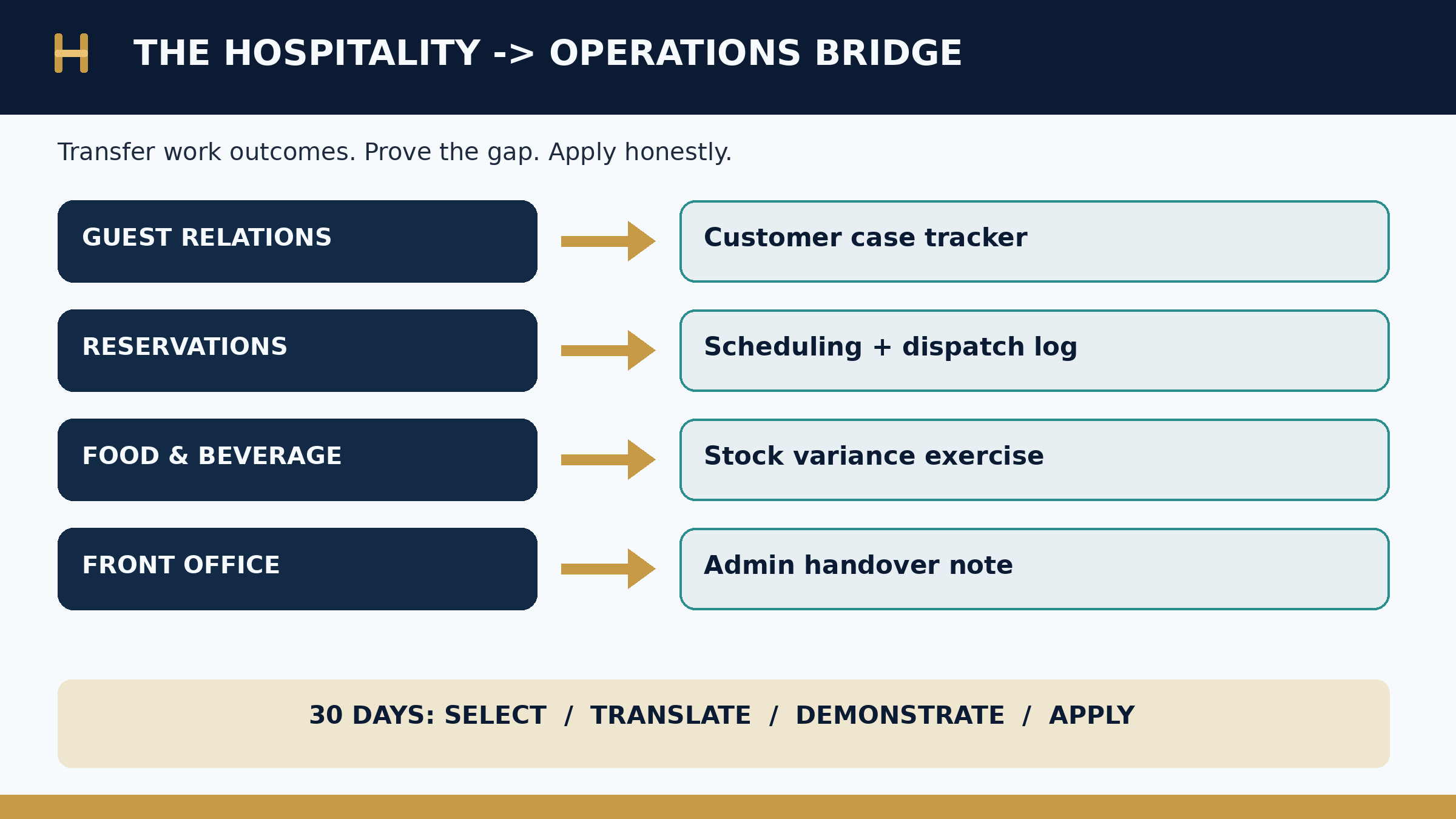
Sample A: customer case tracker. Create a fictional table of 20 service requests with date, category, urgency, owner, due date, status and resolution note. Add a short management summary explaining which issues should be escalated. This shows categorisation, follow-up and written judgement, not just software familiarity.
Sample B: shift-handover note. Write a one-page handover for an imaginary hotel-to-logistics service desk: open cases, promised actions, supplier delays, safety or customer concerns and the next shift's priorities. A good handover distinguishes confirmed facts from assumptions. This can support interviews for administration, customer operations and dispatch support.
Sample C: stock variance investigation. Use fictional receipts, issues and physical counts for ten items. Reconcile the variance and propose a verification step before adjusting records. Do not present the workbook as a real employer audit. If you want structured instruction, the live HumanValue Warehouse, Inventory & Logistics Management course currently lists ERP and Excel exercises at TZS 50,000; review its syllabus and access terms before buying.
5. Rewrite the headline without overstating your experience
A misleading headline says “Experienced Logistics Manager” when the applicant has never managed a logistics function. A more credible alternative is “Hospitality Operations Professional | Scheduling, Service Recovery and Shift Coordination | Transitioning to Customer Operations.” It names the demonstrated capabilities and makes the transition transparent.
In the experience section, keep the true job title and employer. Under it, add three or four achievement-oriented bullets that a new sector understands. For instance, “Maintained accurate reservation changes and communicated service exceptions across three teams” is stronger than “responsible for bookings.” Include numbers only if supported by records. Recruiters can evaluate genuine skills; they should not have to reverse-engineer industry jargon.
Use the JobsTanzania free ATS CV scan or the site's free CV-scanning entry point to check presentation and keyword alignment, but remember that a match score is only a screening aid. The CV & Application Pack Lab is a separate listed paid course for vacancy matching and ATS-friendly CV preparation. Do not purchase it unless its deliverables fit your gap.
6. A 30-day career-bridge plan you can actually finish
Days 1–5: Select. Compare 15 real vacancies across two role families. Note repeated essential tasks, minimum experience, software and location. Pick one primary target. If almost every advert requires a credential you lack, select a more junior bridge role instead of hoping the requirement will disappear.
Days 6–12: Translate. Interview yourself about five real workplace incidents: a service recovery, a schedule conflict, a stock discrepancy, a difficult handover and a confidential-information decision. Write evidence-based CV bullets and request permission to use any non-confidential achievement figures.
Days 13–20: Demonstrate. Complete two fictional-data work samples and one skills-gap exercise. Keep each under two pages or one clean workbook. Ask a trusted practitioner to review whether the work resembles the target role's actual tasks. Correct errors before publishing a portfolio link.
Days 21–26: Position. Update your JobsTanzania seeker profile, headline, experience and current CV. If the platform offers consent controls for employer visibility, review them rather than assuming that uploading a CV authorises unlimited sharing. The employer-facing HumanValue Talent Bank provides structured profile search, but candidates should use accurate information and understand their visibility choices.
Days 27–30: Apply and learn. Submit a small number of tailored applications where the essentials fit. Track role, employer, date, evidence sent, response and feedback. A rejection is not proof that the transition is impossible; it may reveal a genuine missing requirement or an unclear CV. Change one variable at a time.
7. Worked example: a reservations agent targets customer operations
Illustrative scenario, not a real JobsTanzania placement. Asha has three years of reservations and front-desk experience in Arusha. She handled customer changes, maintained booking notes and escalated supplier problems. She wants a customer operations coordinator position in Dar es Salaam. Her first CV lists “good communication, hard-working, computer literate.” It does not explain her work.
Asha reads 12 vacancy descriptions and discovers that most require ticket logging, written updates and spreadsheet reporting. She builds a fictional case tracker, practises a weekly report and rewrites her CV with verifiable shift-handover and escalation examples. She does not claim Salesforce experience because she has never used it. She applies to assistant and coordinator roles, not senior operations manager vacancies. Her preparation is stronger, but interviews and offers remain employer decisions.
8. How to decide whether paid support adds value
Start with the free actions: role research, honest profile completion, a targeted CV and two evidence samples. A paid course is justified when it closes a clearly named technical gap and you can complete the practical exercises. The HumanValue Learning Center publishes current syllabuses and fees. The Job Seeker Premium page lists a separate 30-day career-support product at TZS 30,000 as checked on 22 October 2026; ordinary local job applications remain free. Premium is not a guarantee of employer attention.
If you have no proof of a required skill, spend your first effort producing proof, not buying visibility. A strong career transition is a truthful translation of existing value plus targeted new competence.
Frequently asked questions
Can hospitality experience count toward a logistics role?
Sometimes. Scheduling, handovers, customer communication and basic stock control can transfer. The technical, licensing and safety requirements of the particular logistics job still apply.
Should I remove my hospitality job title from my CV?
No. Keep the genuine title and dates. Explain transferable responsibilities and outcomes under it, then use a target-role headline that clearly signals your career direction.
Do I need a certificate before applying?
Not always. Compare actual vacancies. Some assistant roles emphasise experience and evidence; others require specific training. A certificate is useful when it represents learning that the employer needs, not as decoration.
Can I put a fictional spreadsheet in my portfolio?
Yes, if it is clearly labelled a practice simulation and contains no real customer, employee or employer data. Explain the assumptions and what you would verify in a live operation.
Will a Talent Bank profile guarantee that recruiters contact me?
No. Profile quality and discoverability can support consideration, but hiring depends on vacancy fit, employer demand, candidate consent and verification.
Your practical next step
Choose one real target vacancy, identify three transferable outcomes, and build one fictional-data work sample this week. Then review your JobsTanzania CV and profile, or use the Learning Center catalogue to close a specific gap. The value is in evidence that an employer can assess.
Research and editorial note (22 October 2026): Product information checked against public JobsTanzania pages on this date. ILO recognition-of-prior-learning material and Tanzania PDPC guidance support the skills and privacy principles. Fictional examples are labelled. Course prices and features can change. This is career guidance, not a job or placement offer.