


HumanValue Career Intelligence | Tanzania | Researched 9 November 2026
Choose an HR-assistant opportunity by its actual responsibilities, supervision and learning opportunities, rather than the title alone. Recruitment coordination, HR operations and learning support can all sit within an assistant role, but they develop different capabilities. Compare the work you will do and the decisions you will be allowed to make.
For Tanzanian graduates and early-career administrators, the aim is to find a role where you can perform useful work and build credible evidence. This guide compares three practical work areas. It does not announce vacancies, set universal qualification requirements or promise a particular salary or promotion timetable.
Understand the breadth of the people profession
HR is more than processing forms, but dependable administration matters because people decisions rely on accurate information and timely coordination. A late interview invitation, an unclear record or an untracked learning task can affect colleagues and candidates.
The CIPD Profession Map’s people-practice area describes work across the employee lifecycle. Its specialist areas include resourcing and learning and development. This provides a professional reference for thinking about breadth and specialisation; it is not a Tanzanian licence or an employer’s vacancy specification.
At assistant level, ask how your work connects with those broader responsibilities. A clear reporting line and access to review can matter as much as the number of functions named in the job description.
Compare three work areas before applying
| Work area | Possible coordination work | Evidence of useful performance |
|---|---|---|
| Recruitment coordination | Interview arrangements, applicant records and panel communication | Accurate schedules and clear, authorised updates |
| HR operations | Record indexes, routine requests and approved employee communications | Traceable information and unresolved queries referred correctly |
| Learning support | Invitations, activity logistics, attendance and follow-up records | Reliable coordination without confusing attendance and assessment |
These examples describe possible responsibilities, not a fixed package every employer must use. In a small organisation, one assistant may support all three. In a larger team, the role may focus on one area. Read the specific brief and ask where most of the working time will go.
Recruitment coordination: keep people and decisions aligned
This work suits someone who enjoys organising several participants while maintaining accurate communication. An interview may depend on the candidate, panel, room or meeting link, assessment materials and agreed time. The coordinator needs to identify conflicts and keep changes visible.
The distinction between coordination and selection is important. An assistant may prepare an applicant list or collate panel scores without independently deciding who should be appointed. Learn which messages can be sent from an approved template and which need a manager’s approval.
A fictional practice example could involve two overlapping interview times and one unavailable panel member. Demonstrate a revised proposal and an update request without pretending to have managed a real recruitment campaign. Do not place actual candidate details in a public portfolio.
HR operations: make routine work reliable
This area may appeal to someone who enjoys structured records, careful checking and resolving incomplete information. The challenge is often to distinguish what is confirmed from what still needs a decision. A tidy spreadsheet should not hide a missing approval.
Ask who owns the official record, which systems are used and how corrections are authorised. Supporting a payroll input, leave request or employee letter does not automatically give the assistant authority to decide entitlement, pay or contractual terms.
For an example of the judgement involved, read HumanValue’s HR-assistant file-review guide. Its fictional pack distinguishes a correctable index reference from missing approval and conflicting information. Treat it as a learning example, not a legal compliance checklist.
Learning support: coordinate evidence as well as events
Learning support involves more than booking a venue. A coordinator may need to understand the activity’s purpose, participant needs, materials, schedule and follow-up. The employer should define who approves content and who assesses completion.
Attendance, submitted work, reviewed work and completion may be different statuses. A person can coordinate those records without being the trainer or deciding competence. That distinction is explored in our training-coordinator recruitment guide.
If this area interests you, ask how learning needs are identified and how the organisation checks whether the activity helped. Avoid choosing a role solely because it includes conferences or travel; understand the records and follow-up expected between events.
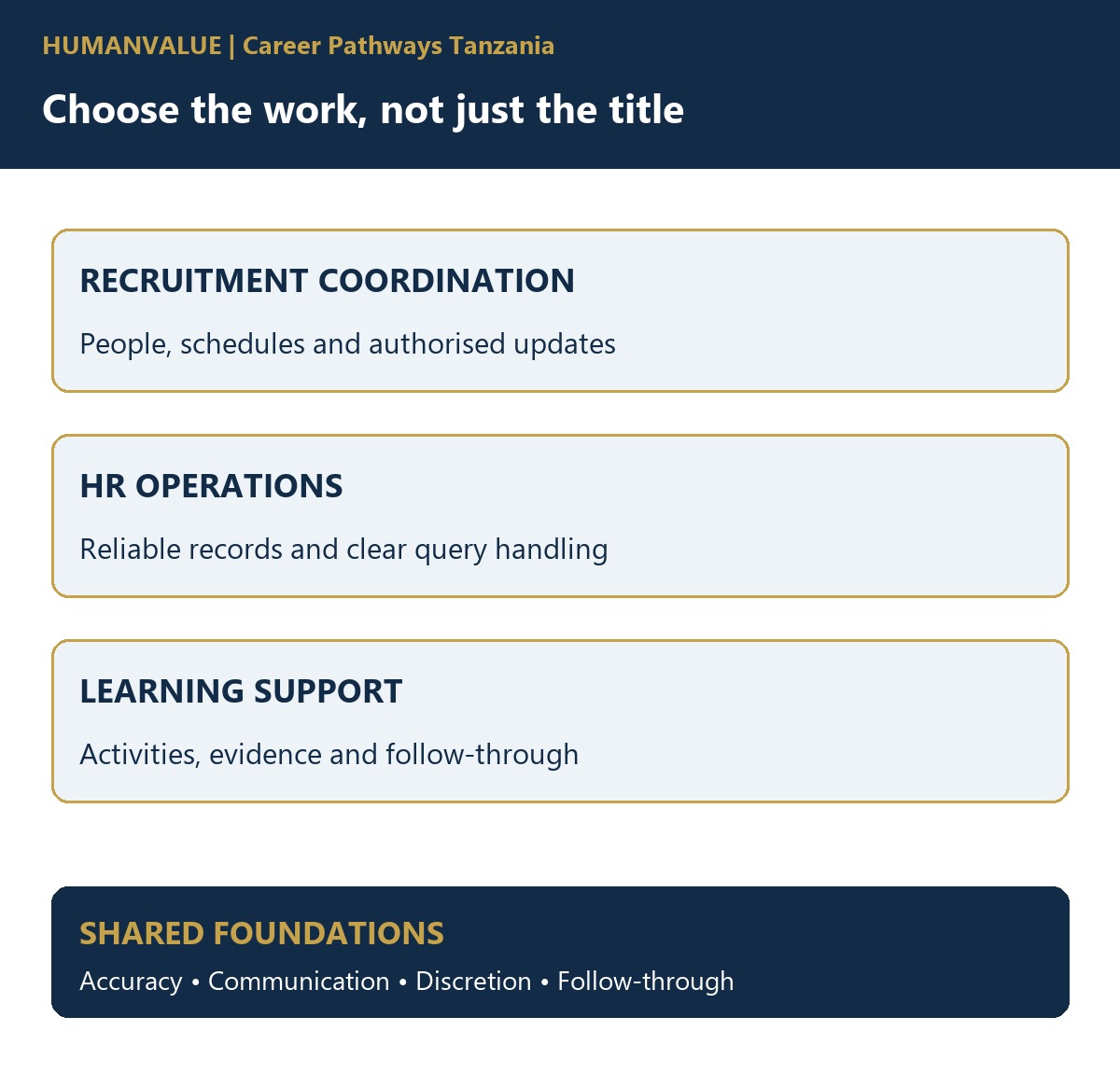
A fictional career decision: compare the supervision, not just the title
Imagine two invented opportunities with the same title. One provides a defined recruitment-coordination remit and regular review by an experienced manager. The other lists recruitment, payroll, employee relations and training but gives no clear reporting line or approval process.
The second role is not automatically better because it sounds broader. Ask how priorities are set, what support is available and which tasks require specialist judgement. Equally, a narrower role is not automatically preferable if it offers little learning or ownership. The decision depends on the actual work and your development needs.
Compare your current evidence against the essential requirements. If you have administrative experience but little HR exposure, explain the transferable skill accurately. Organising a workshop can show coordination; it does not by itself establish expertise in employment law or learning design.
Build a focused development plan
Choose one capability to strengthen first: clear written updates, accurate structured records or coordination of dependencies. Define a practice output and a way to review it. Keep a short learning note explaining what you changed after feedback.
Review Workplace Excel Essentials for spreadsheet development and Microsoft 365 Collaborative Workplace for shared-work practices. Match the resource to the actual gap and check its current scope. A learning resource does not replace employer-specific training or establish a professional designation.
Questions early-career applicants ask
Must I specialise immediately?
No universal rule requires that choice. A broad assistant role can provide exposure when responsibilities and supervision are clear. A focused role can also build depth. Compare the actual opportunity rather than assuming one route is always superior.
Does a job title establish the required qualification?
No. Read the advertised criteria and any applicable professional or legal requirements. Do not assume that one certificate satisfies every employer, or that a short course replaces required education or experience.
How do I describe a practice project?
Label it honestly as fictional or educational. Explain the task, your method, feedback and limits. Keep it separate from employment achievements and never add invented clients or results.
Prepare an application that shows the right evidence
For each vacancy, select examples that match the responsibilities. Recruitment coordination needs evidence of accurate arrangements and communication; operations needs careful handling of records; learning support needs reliable planning and follow-through. Explain your contribution without claiming the manager’s decisions as your own.
The CV & Application Pack Lab is a relevant HumanValue Learning Center resource to review when organising those materials. Employers defining an assistant role can discuss HumanValue HR and recruitment support, agreeing the scope, responsibilities, timing and fees before work begins. The useful starting point is a clear description of the work that needs to be done.